product education · 8 min read
all-natural dog chews, what "natural" should mean.
"natural" is one of the most trusted words on a dog treat bag, and one of the loosest. here's the real definition, what it does and doesn't promise, and what to check instead.
the short version
- "natural" is a real, defined term under AAFCO's model regulations, and most US states enforce it.
- but it's narrower than it sounds: it describes sourcing and processing, not ingredient count, safety, or health value.
- a treat can be legally "all natural" and still carry flavorings, binders, or six ingredients you can't picture.
- single-ingredient is a stricter, easier-to-verify standard: one thing in the bag, nothing to parse.
what does "natural" actually mean on a dog treat label?in most US states, "natural" is a defined term under AAFCO's model regulations: an ingredient derived solely from plant, animal, or mined sources, not produced by a chemically synthetic process, and free of chemically synthetic additives beyond trace manufacturing amounts. it's a real rule, just a narrower one than the word implies.
what the word actually regulates
it governs where an ingredient came from, not what ends up in the bag.
"all natural" sits on more dog treat bags than almost any other phrase, and it's doing more marketing work than regulatory work. and it works: in one industry survey, a "made with natural ingredients" claim influenced the purchase decision of a majority of pet owners. shoppers searching for all natural dog chews usually mean something specific: no weird stuff, nothing my dog can't digest, nothing i'd feel bad reading on the label.
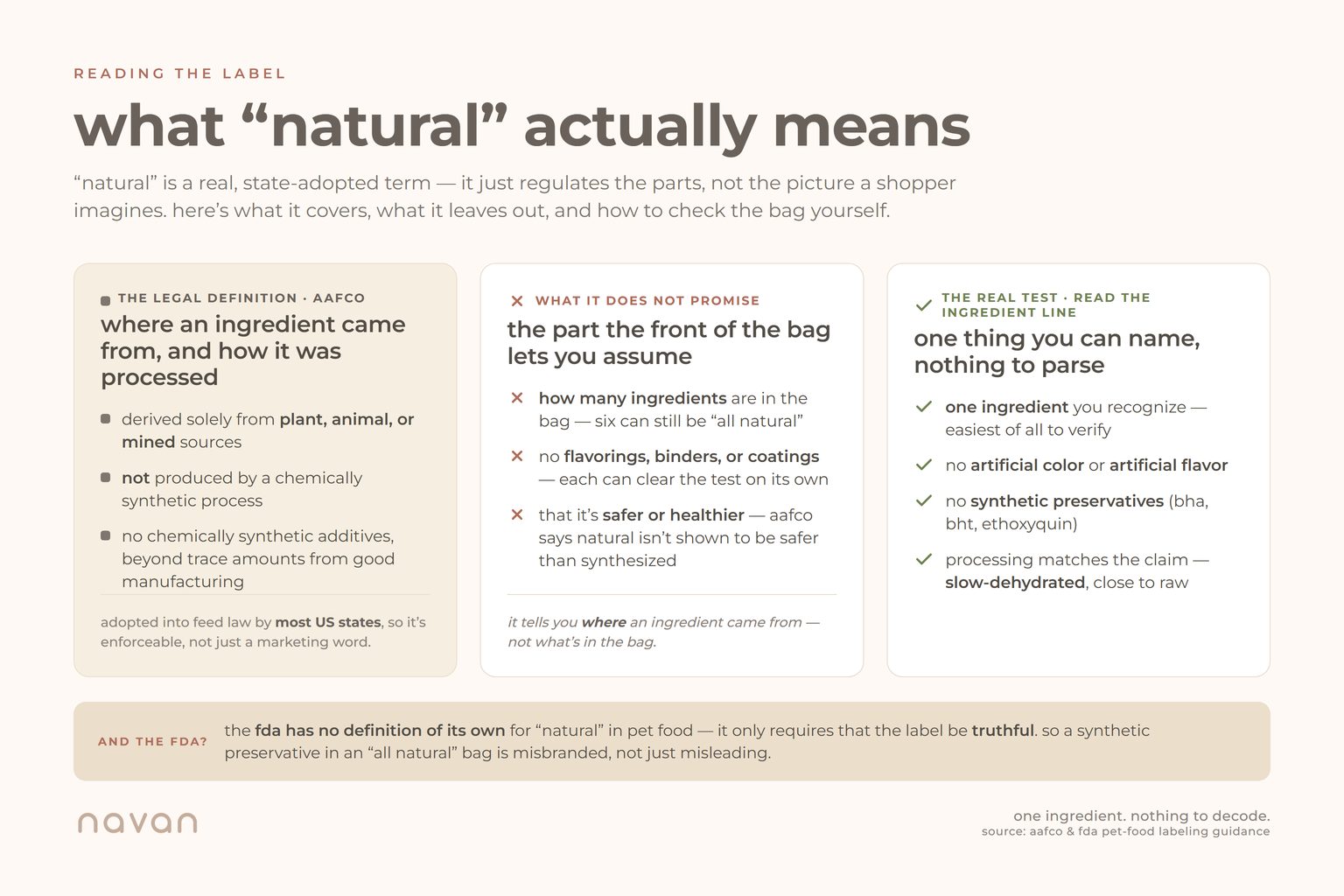
the Association of American Feed Control Officials (AAFCO) defines "natural" as a feed ingredient derived solely from plant, animal, or mined sources, subject only to physical or heat processing, rendering, purification, extraction, hydrolysis, enzymolysis, or fermentation, and not produced by or subject to a chemically synthetic process. most US states have adopted AAFCO's model regulations into their own feed laws, so this isn't just an industry suggestion, it's the standard a labeler has to meet to legally use the word.
notice what the definition actually governs: where an ingredient came from, and how it was processed. it says nothing about how many ingredients are in the bag, how much of each, or what the finished chew does for your dog.
why "all natural" isn't the protected claim you'd hope
the word regulates each part, not the whole picture a shopper imagines.
a dog treat with six or seven ingredients, a natural flavor coating, a plant-derived binder, and a preservative pulled from rosemary extract can legally call itself all natural, because each individual piece traces back to a plant, animal, or mineral source and skips the chemically synthetic process. what it can't do is add an artificial color, artificial flavor, or synthetic preservative and keep the claim. the FDA doesn't have its own definition of "natural" for pet food, but its baseline requirement that pet food be truthfully labeled still applies, so a bag with a synthetic preservative calling itself all natural is misbranded, not just misleading.
| term | is it regulated? | what it actually promises |
|---|---|---|
| natural / all-natural | yes, under AAFCO model regulations (state-adopted) | no chemically synthetic ingredients or additives, beyond trace amounts |
| single-ingredient | no formal AAFCO definition | exactly one component in the bag, verify by reading the ingredient line |
| human-grade | yes, a specific AAFCO standard tied to edible-for-humans facilities | every ingredient and the finished product meet food-grade handling rules |
| organic | USDA-regulated for pet food ingredients | ingredients grown and processed under USDA organic standards |
| grain-free | not independently defined | no grain ingredients, says nothing about additives or ingredient count |
none of that makes "natural" meaningless. it just means the word tells you less than the bag wants you to feel. AAFCO is explicit that its natural definition carries no safety claim: a chemically synthesized vitamin can be perfectly safe, and a naturally derived one isn't automatically gentler on a dog's stomach. what determines whether a chew is a good idea for a specific dog is size, texture, how it's processed, and how much of it fits into that dog's daily calories, not whether the label says natural.
how to verify a "natural" claim instead of trusting the bag
read the ingredient list, not the front label. three checks take under a minute.
- count the ingredients. one is easiest to verify. six is harder, and each one has to individually clear the natural bar.
- scan for the disqualifiers. artificial color, artificial flavor, and synthetic preservatives (like BHA, BHT, or ethoxyquin) can't sit in a bag that legally claims natural.
- match the processing to the claim. slow dehydration keeps a chew closer to its raw form. heavy extrusion or rendering can still meet the natural definition, but it's a different product than a single dried ingredient.
this is the same reason we built our line the way we did: fewer variables to check means fewer places for a claim to quietly stretch. a chew made from one thing, unprocessed beyond drying, with nothing added, leaves the word nothing to do. the ingredient line already says it.

collagen sticks · 15 day supply
$35 one-time · from $29.75/mo on subscription
add to cart → live from shopify · price & stock always currentread the back of the bag. the front is advertising.
the navan take
“natural” is doing a job in this category that a label shouldn't have to do. the word only became necessary because processed food made a one-ingredient product unusual enough to need a name. the trouble with a proxy is that it stretches quietly, and nobody has to lie for the meaning to drift. we'd rather be checkable than described: one part, dried, and an ingredient line that says the same thing as the front of the bag. don't take the adjective. read the back.
frequently asked
what does "natural" mean on a dog treat label?
is "all natural" the same as "single-ingredient"?
does "natural" mean a dog chew is safer or healthier?
how can i tell if a dog chew is really natural?
not sure which chew fits?
find your dog's chew in 60 seconds.
size, texture, and protein, matched to your dog instead of a label claim.
take the chew quiz →sources: Association of American Feed Control Officials (AAFCO), definition of "natural" for pet food and feed labeling, and guidance that natural ingredients carry no inherent safety advantage over chemically synthesized ones; U.S. Food and Drug Administration, FDA's Regulation of Pet Food, on the requirement that pet food be truthfully labeled; Petfood Industry, survey finding a "made with natural ingredients" claim influenced the purchase decision of 52% of pet owners.
want navan's latest guides and updates to reach you more often? add us as a preferred source on google.
add navan as a preferred source on google