
dental health · 6 min read
are dental chews safe for dogs?
choking, upset tummies, broken teeth: the real risks behind dental chews, and the two quick tests that rule out an unsafe one.
the short version
- most dental chews are safe for most dogs, when the size, hardness, and supervision are right.
- the real risks are choking on a worn-down end piece, a fractured tooth from a chew that's too hard, and GI upset from something that doesn't digest.
- two quick checks rule most of that out: the fingernail test for hardness, and sizing so your dog can't fit the whole chew in its mouth.
- they support the routine between professional cleanings, not a substitute for either brushing or the vet chair.
are dental chews safe for dogs?Yes, for most dogs, when three things line up: the chew is sized so your dog can't swallow it whole, it doesn't fail the fingernail hardness test, and you're in the room while your dog eats it. The real risks aren't the ingredient, they're choking on an end piece, a fractured tooth, or an upset stomach.
“Are dental chews safe for dogs” turns up more scare stories than straight answers, and small-dog owners have good reason to ask. A tiny jaw has less room for error than a Labrador's. The honest answer sits in the middle: dental chews are a low-risk, evidence-backed daily habit for most dogs, but only when the chew fits the dog. The actual dangers, choking, a cracked tooth, an unhappy stomach, come from a handful of specific, avoidable mistakes, not from the category of “dental chew” itself. Here's what actually goes wrong, and the two tests that catch most of it before it happens.
The FDA doesn't regulate “dental chews” as a distinct risk category, but it has published detailed warnings about a related product: hard bone treats. The mechanics are the same for any chew. What matters is hardness, size, and whether someone's watching. The Cornell Riney Canine Health Center puts it plainly: fractured teeth are commonly caused by chewing very hard objects, and even ordinary chew toys can be a cause. Their advice is a simple test you can run at home before you ever hand a chew to your dog, more on that below.
can dogs choke on dental chews?
yes, and almost always on the last inch.
Choking risk climbs once a chew wears down small enough to fit fully inside your dog's mouth, or when a hard end piece breaks off and lodges in the throat. It's most common with chews sized wrong for the dog, too big to finish safely or too small from the start. The mechanism is almost always the same: a dog holds a chew with its paws while there's enough of it to grip, then loses that control once it's down to the last inch or two, and tries to swallow the stub whole instead. Small dogs have less margin here, a stub that a 60-pound dog spits out can fully block a 10-pound dog's throat. That's why NAVAN's rabbit ear and duck neck are sized for small mouths specifically, and why we'd rather you take a chew away too early than too late.
| check | why it matters |
|---|---|
| fingernail test | if you can't dent the chew with a thumbnail, it's hard enough to fracture a tooth |
| sized to the mouth | too small and it's a choking risk from the first bite, not just the last one |
| supervised | most choking happens on the last inch, when your dog can no longer hold it with its paws |
| single ingredient | no fillers or additives, easier to spot what did or didn't agree with your dog's stomach |
| removed once small | a chew a dog can fully mouth is no longer a chew, it's a hazard |
are dental chews good for dogs?
yes, as a daily habit alongside brushing.
The right chew's texture creates mechanical abrasion that helps reduce plaque and tartar on the teeth a dog actually chews with. It supports the routine between professional cleanings, it doesn't replace brushing or a vet's cleaning, and dental disease below the gumline still needs a dentist's eyes. The Veterinary Oral Health Council (VOHC) is the closest thing this category has to a nutrition label, its Seal of Acceptance goes only to products that cut plaque or tartar by at least 15% in each of two controlled trials before the claim is allowed on the box. We cover what that seal does and doesn't cover in a separate deep dive on whether dental chews actually work. Short version here: the benefit is real, and it's a supplement to your dog's dental routine, not a swap for the parts a chew can't reach.
reports filed with FDA's Center for Veterinary Medicine on processed bone treats (splintering, choking, broken teeth, GI blockage). these figures describe hard bone treats specifically, not soft single-ingredient chews, but the underlying lesson, hardness and size decide the outcome, applies across the category. source: FDA, "No Bones (or Bone Treats) About It".
not sure which chew fits? size and texture matter as much as ingredient. answer 4 quick questions and get the chew sized right for your dog. try the dog chew finder →
how do i pick a safe dental chew for my dog?
two quick checks rule out the two most common failures.
- run the fingernail test. press a fingernail into the chew. if you can't dent it, it's too hard for teeth.
- size it to the mouth. pick a chew your dog can't fit the whole thing into at once.
- pick a single ingredient. one thing you can pronounce, so an upset stomach is easy to trace.
- stay in the room. supervise while your dog works on it, and take the last piece away.
The American Kennel Club recommends the same sizing logic: pick a chew wide enough that your dog can't get the whole thing in its mouth at once, and take it away once it's worn down to a stub. Combine that with Cornell's fingernail test for hardness, and you've ruled out the two most common ways a dental chew goes wrong. Everything past that, ingredient, texture, digestibility, is preference and dietary fit rather than a safety question.
So, are dental chews safe? For a small dog with the right size, the right hardness, and a person nearby, yes, and the daily habit is worth keeping. What isn't worth it: a chew too hard to dent, too small to matter, or eaten unsupervised.
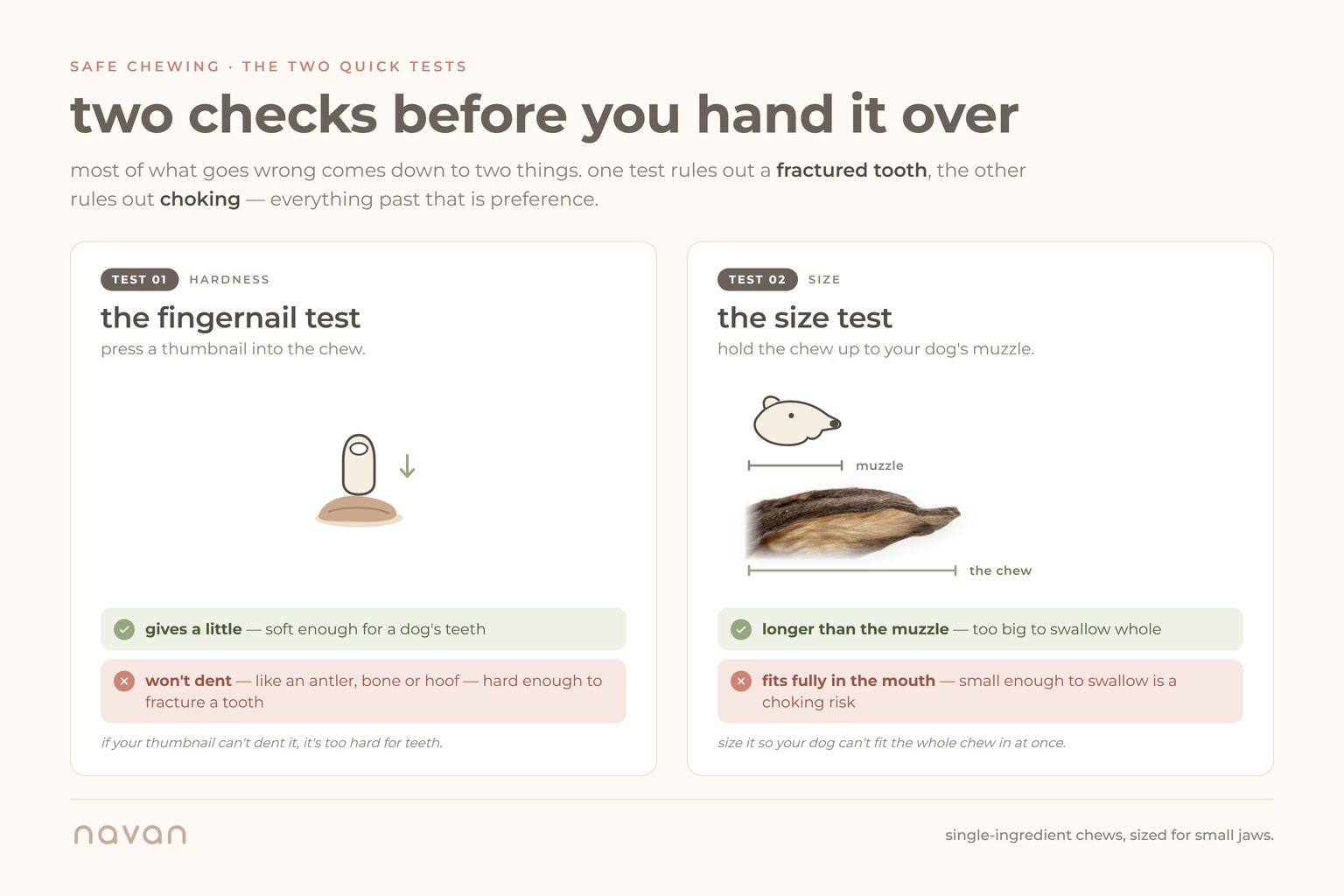
press a thumbnail into it before you buy it. if nothing gives, nothing will give in your dog's mouth either.

rabbit ears · 10 day supply
$35 one-time · from $29.75/mo on subscription
add to cart → live from shopify · price & stock always currentthe navan take
safety isn't something we can print on a bag and have you believe, so here are the two things we test for instead. first, the material has to give before a tooth does, which you can check with a thumbnail before you ever buy it. second, the piece has to be too large to swallow whole and small enough for the jaw in front of you, which is why we size for small dogs and say so on the label. everything past those two is supervision, and supervision is yours.
frequently asked
are dental chews safe for dogs?
can dogs choke on dental chews?
are dental chews good for dogs?
how do i pick a safe dental chew for my dog?
not sure where to start?
build your dog's dental protocol in 60 seconds.
answer a few quick questions and we'll match the single-ingredient chews that fit your dog's size, mouth, and needs.
take the dental quiz →sources: Cornell University Riney Canine Health Center, "Risks from a fractured tooth", on chew hardness and the fingernail test; U.S. Food and Drug Administration, "No Bones (or Bone Treats) About It: Reasons Not to Give Your Dog Bones"; American Kennel Club, on sizing edible chews to prevent choking; Veterinary Oral Health Council, trial protocol requirements for the Seal of Acceptance.
want navan's latest guides and updates to reach you more often? add us as a preferred source on google.
add navan as a preferred source on google