
dental · 7 min read
are greenies bad for dogs?
the honest, VOHC-checked answer, and a single-ingredient alternative for small dogs.
the short version
- greenies are VOHC-accepted for reducing plaque and tartar, the seal is real, not decorative.
- the real caveats: a documented 2005 to 2006 digestibility history (since reformulated), and a gulping or choking risk that applies to any hard chew sized wrong.
- they're a processed, multi-ingredient formula, wheat flour, glycerin, wheat gluten, gelatin, not a single whole-food ingredient.
- a single-ingredient chew, rabbit ear, duck neck, collagen, does the same daily chewing job with one ingredient you can name.
are greenies bad for dogs?Greenies aren't inherently bad for dogs. They hold the Veterinary Oral Health Council (VOHC) seal for reducing plaque and tartar, and most dogs chew and digest them without incident. The real caveats: a documented digestibility history since reformulated, a gulping risk with the wrong size, and that they're a processed, multi-ingredient formula rather than a single ingredient.
"Bad" is doing a lot of work in that search query, so it helps to separate the two things people usually mean by it. Start with efficacy. The VOHC seal isn't a marketing badge a brand can buy. Per VOHC's own trial protocol requirements, a product needs a statistically significant plaque or tartar reduction of at least 15% in each of two independent trials, with a 20% mean across both, before it's allowed on the box. Greenies has held that seal for plaque and tartar since 2019, per VOHC's accepted-products list. Then safety: the caveats below are real, but they're specific. They aren't a reason to call the whole category dangerous.
what are greenies made of?
a formulated starch-and-protein matrix, not a whole food.
Per the manufacturer's own ingredient panel, Greenies Original lists wheat flour, glycerin, wheat gluten, gelatin, water, powdered cellulose, and lecithin ahead of minerals and natural poultry flavor. It's a formulated starch-and-protein matrix, engineered to hold a chewy shape and stay shelf-stable, closer to a baked good than a single whole-food ingredient.
Glycerin does most of the structural work here. It's a humectant, which keeps the chew pliable on a shelf for months. That's a reasonable engineering choice for a shelf-stable, mass-market product. It's just a different starting point than a whole-food chew. Greenies also sells a grain-free version that swaps the wheat for other starches, which tells you the formula is built to be adjusted rather than fixed to one food.
can greenies make a dog sick or choke?
a real but specific history, with dates.
This is history worth stating plainly, with dates. In 2005 and early 2006, veterinarians and the press reported cases of dogs developing gastrointestinal obstructions after swallowing pieces of Greenies. By March 2006, the FDA's Center for Veterinary Medicine had opened a review and the manufacturer changed its label, as dvm360 reported at the time. Mars Petcare acquired the brand later that year. On its own current brand site, Greenies states that its teams "prioritized implementing rigorous digestive solubility testing and formulation shifts" following the acquisition. To be clear, this is a documented 2005 to 2006 episode, attributed, not a claim about today's product. The precaution that outlives any single brand's history is the same one vets give for every chew: match the size to the dog, and watch while it eats.
what is a natural alternative to greenies?
the same daily job, one ingredient long.
The mechanical part of dental care, the part that scrapes a tooth as a dog chews, doesn't need a molded, multi-ingredient shape. It needs something dense enough to ask for real jaw work. That's the case for a single-ingredient chew.
fewer to formulate around
one ingredient means nothing engineered for shelf life, no humectant added to keep it soft, no binder holding a molded shape.
less to react to
fewer things a sensitive dog can react to, because there's only one recognizable ingredient in the bag.
one ingredient you can name
one ingredient you can actually point to on the label, in the animal's natural shape, slow-dehydrated rather than extruded.
| processed chew (e.g., greenies) | single-ingredient chew (e.g., navan) | |
|---|---|---|
| ingredients | wheat flour, glycerin, wheat gluten, gelatin, water, cellulose, lecithin, minerals, flavor (per manufacturer label) | one ingredient, rabbit ear, duck neck, or collagen |
| VOHC seal | accepted for plaque + tartar, since 2019 | not currently VOHC-evaluated |
| shape | molded/extruded to a uniform shape | the animal's natural shape |
| shelf stability | glycerin keeps it pliable on the shelf | slow-dehydrated; no humectant added |
| sizing | sized by weight range per package | sized by weight/jaw per package |
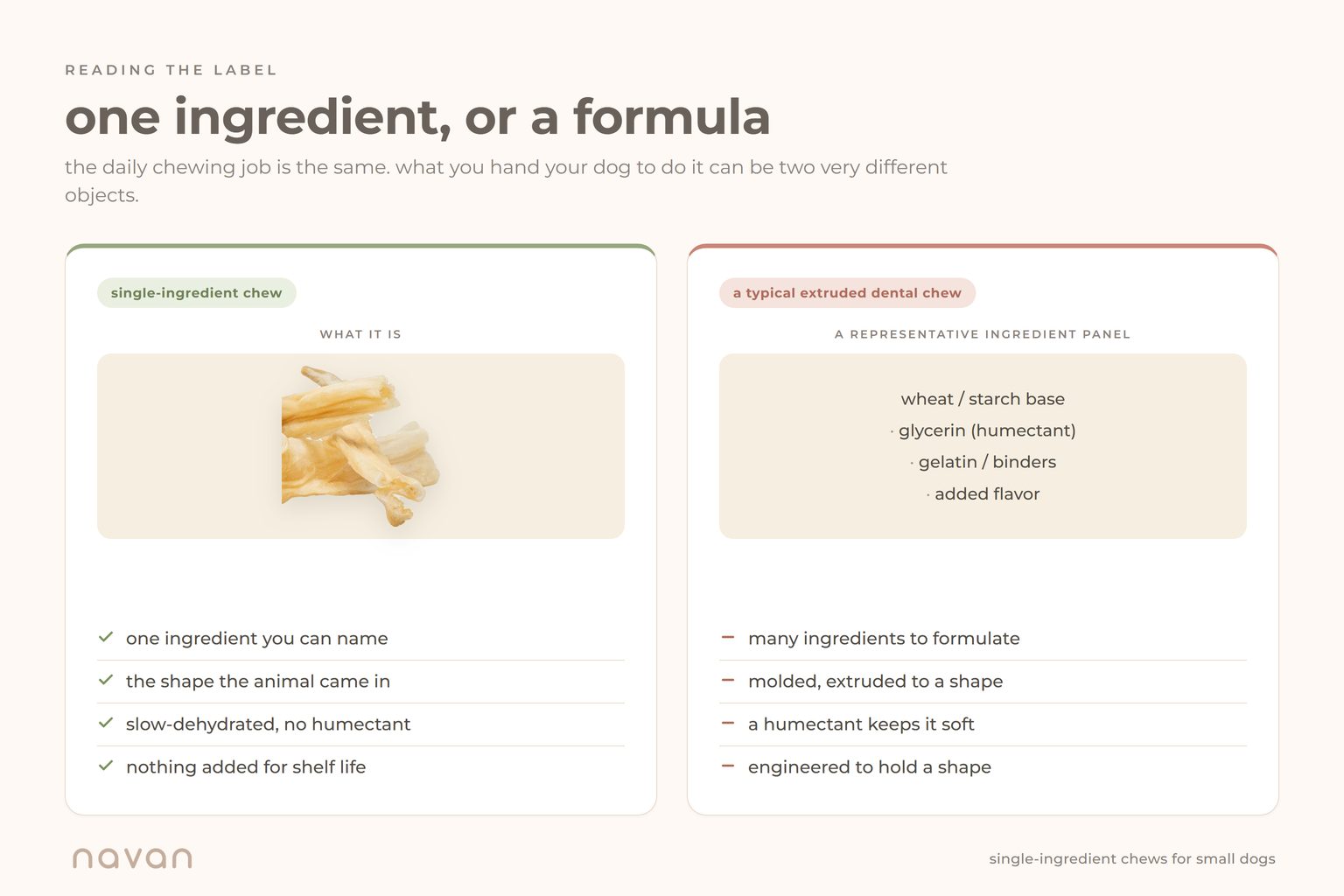
That's the swap we'd make: keep the daily chewing habit, and give it a job that's one ingredient long.
a formula has to be engineered into a shape. an ear already came in one.

rabbit stick · 10 day supply
$35 one-time · from $29.75/mo on subscription
add to cart → live from shopify · price & stock always currentthe navan take
we'll give the competition its due. a molded dental treat can pass a plaque trial, and the market leader has. our disagreement isn't about whether it works, it's about what has to be true for it to work. a formula has to be engineered into a shape, held there with binders, and kept shelf-stable for a year. a duck neck or a rabbit ear arrives in a shape the animal already made, and the only process is drying. we'd rather sell the part than the formula, and have you read the whole label out loud.
frequently asked
are greenies bad for dogs?
what are greenies made of?
can greenies make a dog sick or choke?
what is a natural alternative to greenies?
not sure where to start?
build your dog's dental protocol in 60 seconds.
answer a few quick questions and we'll match the single-ingredient chews that fit your dog's size, mouth, and needs.
take the dental quiz →sources: Veterinary Oral Health Council, trial protocol requirements (minimum 15% reduction per trial, 20% mean across two trials); VOHC accepted products list, Greenies, plaque + tartar seal since 2019; dvm360, reporting on the 2006 FDA Center for Veterinary Medicine review and label change; GREENIES brand site, on the 2006 Mars Petcare acquisition and subsequent digestive-solubility testing; manufacturer ingredient panel for Greenies Original dental treats.
want navan's latest guides and updates to reach you more often? add us as a preferred source on google.
add navan as a preferred source on google