chews · reading time 7 min
the longest lasting dog chews for small dogs
durable doesn't have to mean dangerous. how density, structure, and your dog's own chew style decide what actually lasts, and where "long-lasting" turns into a tooth risk.
the short version
- the longest lasting dog chews for small dogs are dense and single-ingredient, not just the hardest thing on the shelf.
- density, structure, and protein matter, but your dog's own chew style changes everything.
- vets warn that a chew too hard to dent with a fingernail can fracture teeth, and durability shouldn't cost that.
- match the chew to the chewer: rabbit ear for gentle nibblers, duck neck for average chewers, rabbit stick or collagen sticks for power chewers.
what are the longest lasting dog chews?
short answerfor small dogs, the longest lasting dog chews are dense, single-ingredient options, duck neck, rabbit stick, and collagen sticks, rather than thin treats that soften in minutes. but no chew has a fixed lifespan: a gentle nibbler and a determined chewer finish the same piece at very different speeds.
"longest lasting" is really a ratio, not a fixed trait of the chew. a dense, single-ingredient chew gives a dog more material to work through than a thin strip or a hollow treat. that part's straightforward. what isn't fixed is the denominator: your dog's size, jaw strength, and whether they nibble patiently or go straight in. so the honest way to shop this category is by relative density and structure, then adjust for the dog in front of you.
what makes a dog chew last longer?
three things about the chew, and one about the dog.
and then there's the dog. jaw strength, size, and temperament decide the actual clock more than the chew's spec sheet does. that last point is why two owners can buy the identical chew and report wildly different "how long did it last" answers. neither is wrong. they just have different dogs.
are hard, long-lasting chews safe for a dog's teeth?
this is the part of "longest lasting" worth slowing down for. it's tempting to treat hardness as a feature: the harder it is, the longer it survives. veterinary dentistry doesn't see it that way. cornell's riney canine health center recommends a fingernail test. if you can dent the chew, it has enough give. if you can't, it's hard enough to shear off a piece of tooth, most often the large upper premolar. their guidance names antlers, hooves, and bones specifically as things to avoid for that reason. vca animal hospitals says the same in different words, toss anything that doesn't "readily bend", and points to the veterinary oral health council (vohc) seal as a shortcut for products checked for safety.
none of this makes long-lasting chews unsafe. it means durability and hardness aren't the same thing. a chew can hold up for a long, satisfying session and still have enough give to pass the fingernail test. that's the target, not a contradiction.
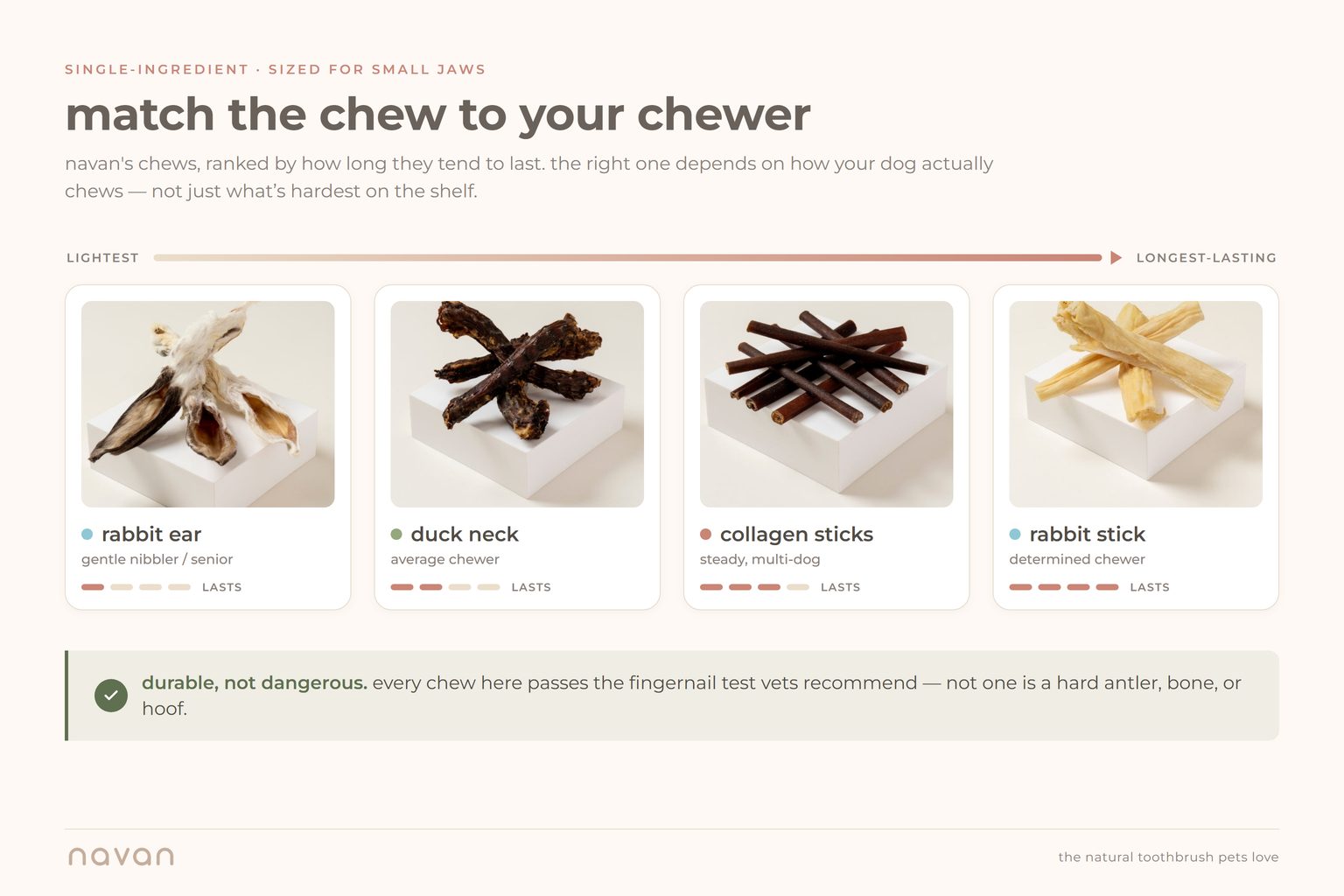
none of the options below is a hard antler, hoof, or bone. here's how navan's single-ingredient chews tend to rank by how long they last, densest first, and why each still passes the fingernail test the vets above recommend:
| chew (most durable first) | relative durability | why it stays tooth-safe |
|---|---|---|
| rabbit stick | highest, a dense piece with a collagen core | slow-dehydrated, not baked rock-hard; still gives under a fingernail |
| collagen sticks | high, consistent single-ingredient density | firm but flexible, with no antler-hard shear point |
| duck neck | moderate to long, segmented vertebrae slow the pace | worked joint by joint rather than as one solid block |
| rabbit ear | lightest, rewards steady, patient gnawing | thin and pliable, easiest on soft or senior teeth |
ranking is relative, not a stopwatch. whichever you pick, size it for a small jaw and supervise every session.
which long-lasting chews are best for small dogs?
match the chew to the chewer, not to the shelf.
rather than chase one "hardest" chew, it helps to sort by chewer type. here's how navan's single-ingredient lineup maps onto that, in broad terms, since actual time varies by dog:
| chewer type | a good starting chew | why |
|---|---|---|
| gentle nibbler / senior | rabbit ear | light structure that still takes steady, patient gnawing to finish; easy on softer or older teeth |
| average / moderate chewer | duck neck | segmented vertebrae slow the pace piece by piece, for more chew time per gram |
| dedicated / determined chewer | rabbit stick | a denser piece with a collagen core that holds up longer under sustained pressure |
| rotating between dogs | collagen sticks | a consistent, single-ingredient density that works across multiple small dogs without escalating hardness |
not sure which column your dog falls into? watch one session. does the chew vanish in a single sitting, or does your dog set it down and come back to it later? that one observation tells you more than any package claim.

what a long-laster should be
- 1 ingredient
- 0 glycerin
- 0 starch
- slow air-dried
- passes the fingernail test
- sized for small jaws
antler lasts for hours. so does a cracked molar.
duck neck · 6 day supply
$35 one-time · from $29.75/mo on subscription
add to cart → live from shopify · price & stock always currentthe navan take
“longest lasting” is the one claim in this category we're careful with, because the cheapest way to win it is to sell something hard enough to break a tooth. antler, hoof and weight-bearing bone all last beautifully, and all three turn up in fracture cases. so the number that matters isn't minutes, it's whether the material gives before enamel does. press a thumbnail into it: if nothing yields, nothing will yield when a molar lands either. the long chew was never about hardness anyway. it was about time, which is the one thing a dog's original diet handed over for free.
frequently asked
what are the longest lasting dog chews?
what makes a dog chew last longer?
are hard, long-lasting chews safe for a dog's teeth?
which long-lasting chews are best for small dogs?
not sure where to start?
build your dog's dental protocol in 60 seconds.
answer a few quick questions and we'll match the single-ingredient chews that fit your dog's size, mouth, and needs.
take the dental quiz →sources: cornell university college of veterinary medicine, riney canine health center, risks from a fractured tooth, the fingernail test; vca animal hospitals, fractured teeth in dogs: causes and prevention; veterinary oral health council, accepted home-care products; american veterinary medical association, pet dental care (periodontal disease prevalence).
want navan's latest guides and updates to reach you more often? add us as a preferred source on google.
add navan as a preferred source on google