dental · 6 min read
dog teeth cleaning without anesthesia: what to know.
it sounds gentler and cheaper, no anesthesia, no risk. the reality is the opposite of what it looks like, and the veterinary consensus is clear.
the short version
- the AVDC advises against anesthesia-free ("non-professional") dental scaling.
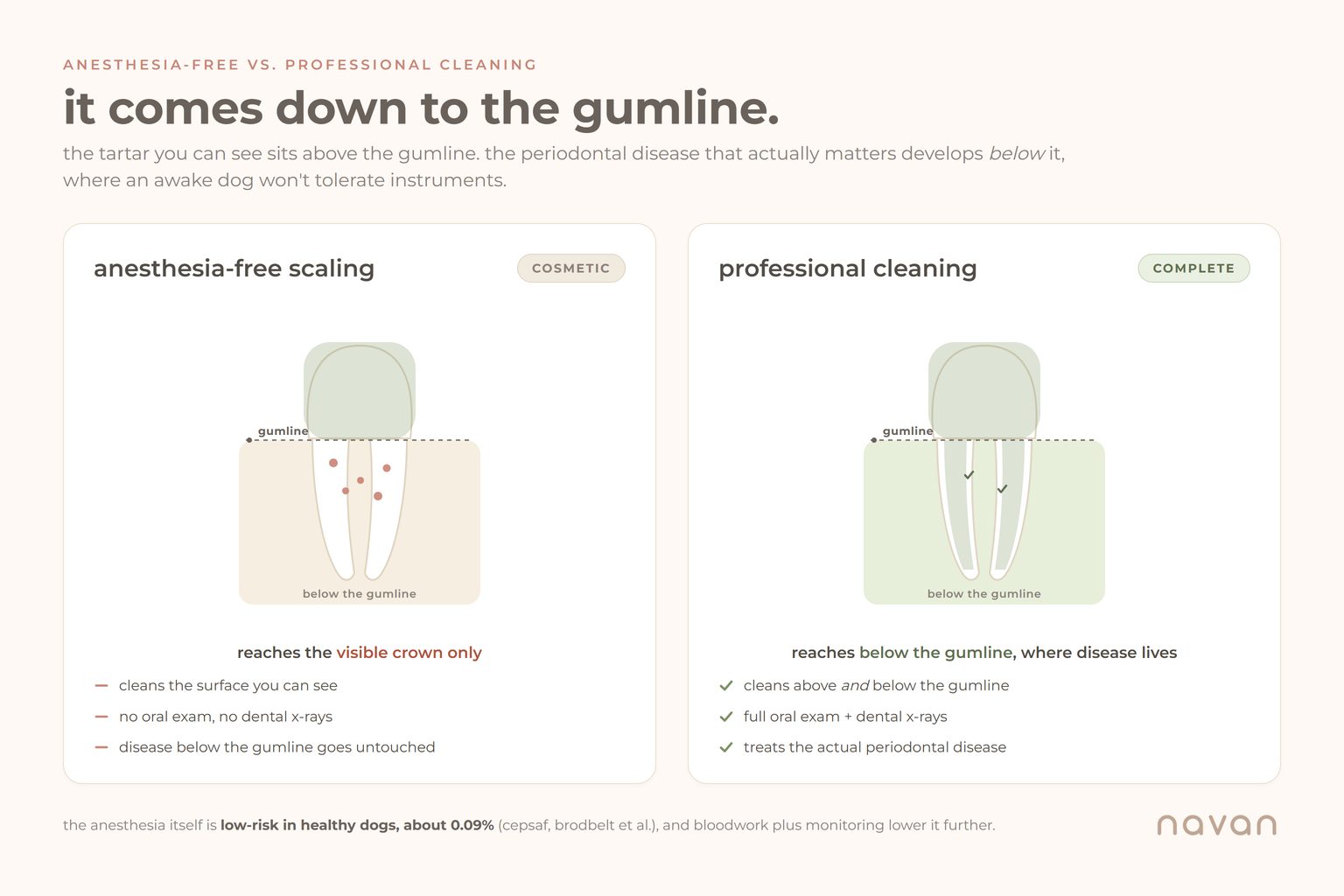
- it cleans only the visible surface, it skips below the gumline, the oral exam, and X-rays, where disease actually hides.
- anesthesia risk is low in healthy dogs (about 0.09%); bloodwork and monitoring lower it further.
- the real at-home role is daily prevention, brushing and chews, between proper cleanings.
is anesthesia-free dog teeth cleaning safe?the American Veterinary Dental College advises against it. anesthesia-free scaling (which the AVDC calls non-professional dental scaling) only cleans the visible tooth surface, can injure the gums if the dog moves, risks aspiration without a protected airway, and skips the below-the-gumline cleaning, oral exam, and X-rays that a real cleaning requires.
what anesthesia-free cleaning actually does
the AVDC prefers the term non-professional dental scaling (NPDS).
its position statement has stood since 1998, and the objection is mechanical rather than philosophical. dental tartar bonds hard to the tooth, and lifting it off takes sharp, powered instruments. on an awake dog, that runs into real limits and real risks:
- only the visible surface gets touched. removing plaque and calculus above the gumline doesn't address periodontal disease, which develops below it.
- no exam or X-rays. a proper cleaning includes probing every tooth and intra-oral radiographs, how vets screen for oral cancer, endodontic disease, and hidden inflammation. awake, none of that happens.
- injury risk. a single head-jerk against a sharp scaler can lacerate the gum, and the handler can be bitten.
- aspiration risk. without a breathing tube to protect the airway, debris and fluid can be inhaled into the lungs.
so the teeth look cleaner while the disease that matters goes unexamined and untreated.
but isn't the anesthesia the real risk?
for a healthy dog, modern anesthesia is low-risk.
this is the fear driving the whole trend, so it's worth answering with numbers. the largest study of its kind (the CEPSAF study, Brodbelt et al.) put the overall anaesthetic-related death risk in dogs at about 0.17%, and around 0.09% in healthy dogs, figures that predate many of today's monitoring standards. pre-anesthetic bloodwork, an IV catheter, and trained monitoring push it lower still. it isn't zero, and it climbs with age and illness. that's exactly why a vet screens first and tailors the plan, and why it's worth talking through with yours.
anesthesia-free vs a professional cleaning
what each one reaches, and what it leaves behind.
| anesthesia-free (NPDS) | professional (anesthetized) | |
|---|---|---|
| below the gumline | not cleaned | cleaned |
| oral exam + X-rays | no | yes |
| treats gum disease | no (cosmetic) | yes |
| injury / aspiration risk | higher (awake) | controlled (airway protected) |
| AVDC position | advises against | recommended |
if the teeth need cleaning, they need the real procedure. anesthesia-free scaling doesn't lower the risk of dental disease, it just hides how much is there.
the safer path: prevention plus proper cleanings
the way to need fewer deep cleanings is to control plaque every day.
so less tartar forms in the first place. that's what at-home dental care is for, paired with the professional cleanings your vet recommends:
- brush when you can. daily brushing is the gold standard for lifting plaque before it hardens into tartar.
- add a daily dental chew. a hard, single-ingredient chew scrapes the teeth through everyday gnawing, above and below the gumline.
- use a VOHC-accepted water additive. it helps control plaque between brushings, with no cosmetic scale required.
navan makes single-ingredient dental chews for small dogs for that daily job, supporting the routine between cleanings, not pretending to replace one.

rabbit ears · 10 day supply
$35 one-time · from $29.75/mo on subscription
add to cart → live from shopify · price & stock always currenta hand scaler reaches what you can see. the disease sits under the gumline, where it cannot go.
the navan take
what an anesthesia-free cleaning sells is a photograph. the teeth look better afterward, and that's the trouble, because the part that hurts a dog happens under the gumline where a hand scaler and an awake patient can't go. a clean-looking mouth with untreated disease underneath is worse than an obviously dirty one, because nobody books the x-ray. our position isn't a shortcut around the vet. it's to spend the money on the real procedure, and spend the ordinary days in between on something dull and repeatable.
frequently asked
is anesthesia-free dog teeth cleaning safe?
does anesthesia-free teeth cleaning actually work?
how many dogs die from teeth cleaning under anesthesia?
what is the alternative to anesthesia-free cleaning?
not sure where to start?
build your dog's dental protocol in 60 seconds.
answer a few quick questions and we'll match the single-ingredient chews that fit your dog's size, mouth, and needs.
take the dental quiz →sources: American Veterinary Dental College (position statement on companion animal dental scaling without anesthesia); American Veterinary Medical Association (below the surface of anesthesia-free dentistry); Brodbelt et al., CEPSAF, the Confidential Enquiry into Perioperative Small Animal Fatalities (Veterinary Anaesthesia and Analgesia, 2008); Veterinary Oral Health Council (accepted home-care products).
want navan's latest guides and updates to reach you more often? add us as a preferred source on google.
add navan as a preferred source on google