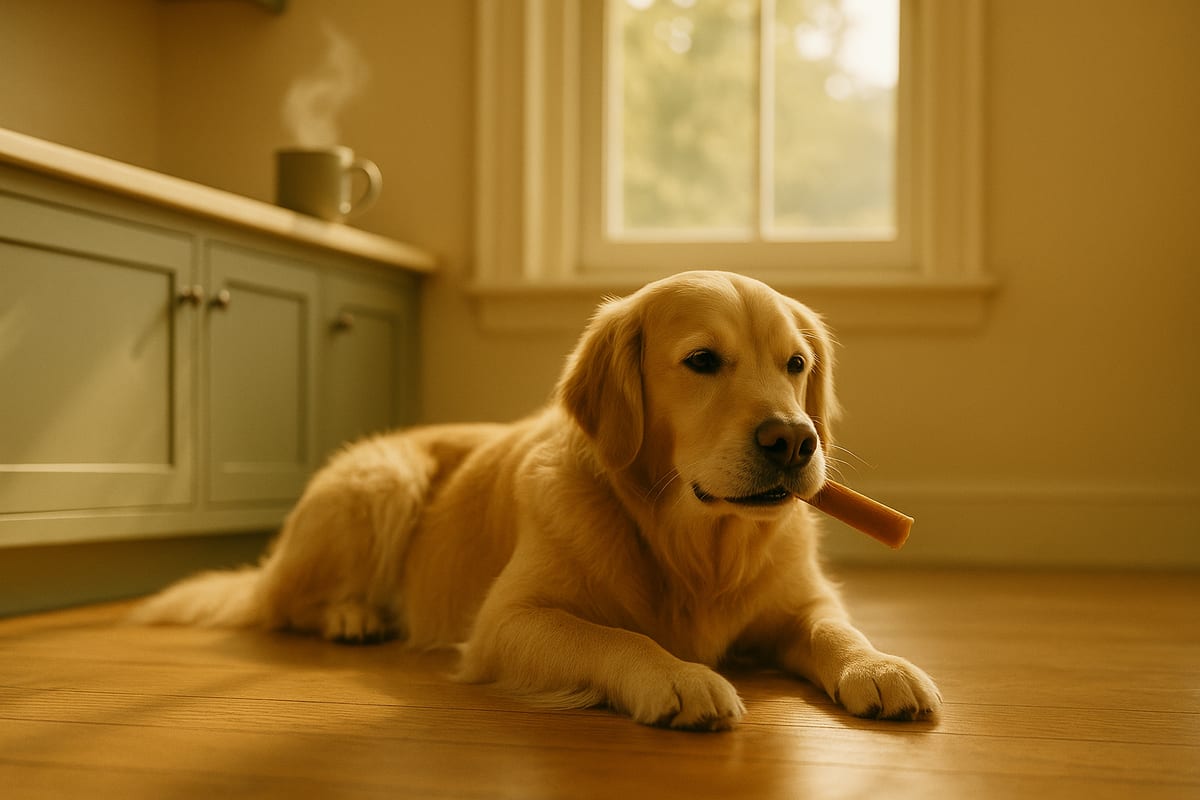
We built a chew. We did not build a ritual. The ritual is something owners brought to us — in emails, in DMs, in the kind of offhand line that shows up at the end of a review: “She knows. She waits by the cabinet at 7:15.”
At first we filed those notes under “cute.” Then they kept arriving. Same shape, different houses. A small dog, a quiet kitchen, a chew handed over while the kettle was on. The owner went about their morning. The dog settled — really settled, in the way dogs do when something has clicked. And the day started softer than it used to.
We wanted to understand why. So we went to the literature, and then we went back to the inbox.
1. What chewing actually does to a nervous system
Chewing is not a passive act. It is one of the few voluntary behaviors that reliably tugs on the hypothalamic-pituitary-adrenal axis — the system that governs how a mammal handles stress. A 2015 review in BioMed Research International by Kubo and colleagues, summarizing decades of work from the Onozuka lab and others, found that sustained mastication during a stressor attenuates the rise in plasma corticosterone and catecholamines that the stressor would otherwise produce. In rodents asked to chew on a wooden stick during restraint, the stress response measurably softened.
Human studies point the same direction, if less tidily. Scholey and colleagues (2009), publishing in Physiology & Behavior, reported that participants chewing gum during an acute laboratory stressor showed lower salivary cortisol and lower self-reported anxiety than non-chewers. Not every gum study replicates. But the working hypothesis is durable: rhythmic jaw movement nudges the autonomic system toward parasympathetic — the “rest and digest” branch — and turns the volume down on the stress axis.
Dogs were not the subjects of those papers. But the wiring is shared. The HPA axis works the same way in a beagle as it does in a graduate student.
2. Why a predictable cue does a separate job
Then there is the ritual itself — the cabinet at 7:15. That part is doing different work, and it is also well-described.
Dr. Karen Overall, the veterinary behaviorist whose Protocol for Relaxation (1997) is widely taught in canine behavior practice, has spent her career arguing that predictable, repeatable sequences are how dogs learn to self-soothe. Not novelty. Not enrichment for its own sake. The same cue, in the same order, at roughly the same time — which the dog can anticipate, prepare for, and resolve. The anticipation is part of the regulation.
Patricia McConnell, writing for years on the everyday biology of stress in dogs, makes a related point: the dogs who fall apart easiest are usually the ones whose days have no shape. A shaped day — even loosely shaped — gives the nervous system landmarks.
Owners kept describing the same thing without the same words: the dog gets the chew, the chew gets the dog. Then the house gets quieter.
3. The owner notes — what they actually told us
We pulled four representative notes from a few hundred. None of these are direct quotes from a single named customer; we have composited them so the patterns are legible and the people stay anonymous.
- The 7:15 dog. “She used to follow me around the kitchen, underfoot. Now she goes to her bed with the chew. I get my coffee. We both win.”
- The reactive rescue. “He needed twenty minutes to come down from the morning walk. The chew is the twenty minutes. By the time he’s done he’s asleep.”
- The senior. “I thought she’d lost interest in food things. The rabbit ear is the one thing she still gets excited about. It’s become her cue that the day has started.”
- The puppy household. “It is the only ten minutes of the day where nobody is asking anybody for anything. We didn’t know we needed that.”
None of those are clinical outcomes. They are something quieter — the texture of a household, slightly changed. But they line up with what the literature would predict: sustained chewing on something biologically appropriate, performed on a predictable cue, against a calm backdrop. Three ingredients, one effect.
4. What we changed once we noticed
We did not redesign the chew. The chew was already the chew. What we did do was rewrite the protocol to name the ritual explicitly — to stop describing the product as a treat and start describing it as a daily anchor. Most of our customers were already using it that way. We were the last to catch on.
5. If you want to try it
A practical shape, drawn from the notes:
- Pick a time and a place. Same kitchen, same bed, same fifteen-minute window. The cue does the work.
- Choose a chew that takes real time. A two-minute chew is a snack. A ten-to-twenty-minute chew is a regulation event. The core bundle is built around this duration.
- Stay out of it. Don’t narrate, don’t hover. The settle is what you’re after, and the settle requires you to leave the room — or at least, leave the dog alone.
None of this is novel. Veterinary behaviorists have been making this case for decades. What is novel — to us, anyway — is how quickly a household reorganizes around a small, repeatable, biologically real thing. We built a chew. The owners built the ritual. The dogs, it turns out, were waiting for both.
Sources: Kubo et al., “Mastication as a Stress-Coping Behavior,” BioMed Research International (2015); Scholey et al., Physiology & Behavior (2009); Karen Overall, DVM, “Protocol for Relaxation” (1997); Patricia McConnell, “The Other End of the Leash.”