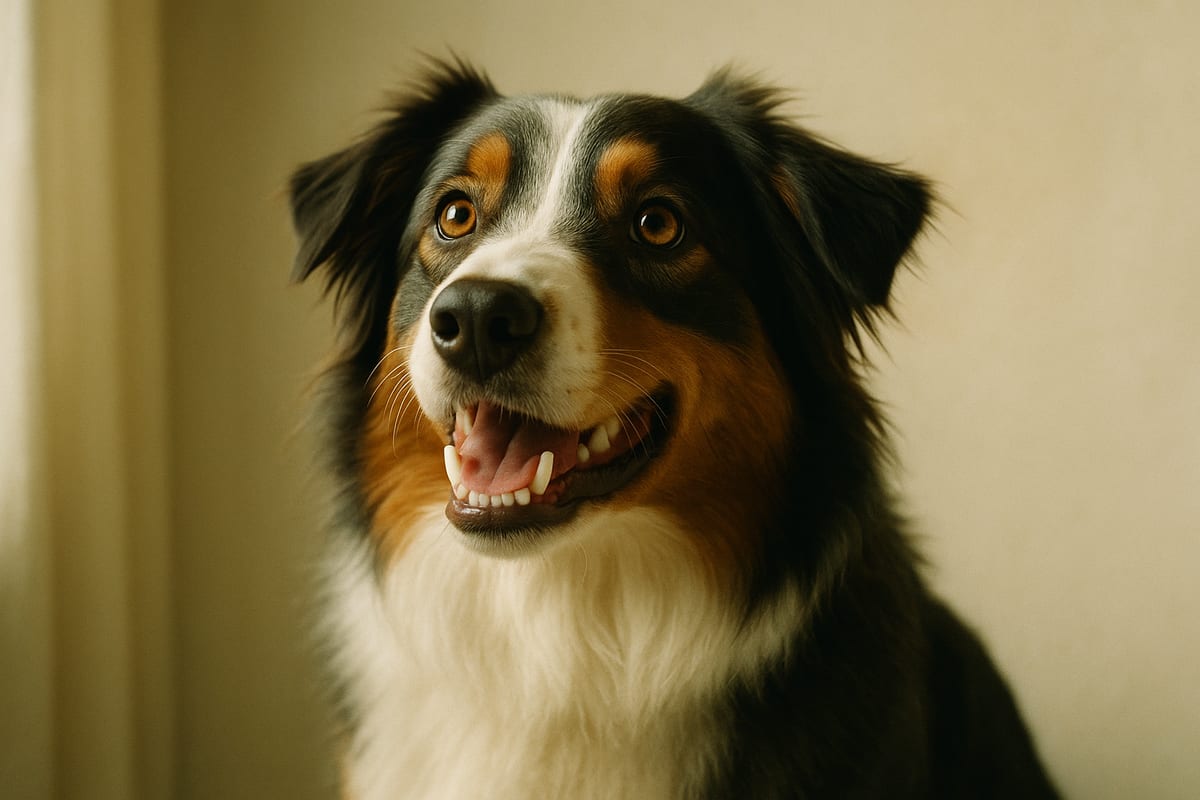
By the time most owners notice their dog has a dental problem, the problem has usually been building quietly for a while. That isn't a guess. The 2019 AAHA Dental Care Guidelines for Dogs and Cats open with a sobering line: by age three, the majority of dogs already have some form of periodontal disease, along with the pain and inflammation that come with it. The disease is the most prevalent clinical condition in pet dogs, full stop.
The reason it gets missed isn't negligence — it's that the early signs don't look like signs. They look like quirks. A slightly different smell. A subtle shift in how a dog eats. A new habit of rubbing the side of the face on the couch. None of these set off alarms. They get filed under “just being a dog.”
This piece is a translation guide. Four signs, ranked by how often we hear them dismissed, with the science underneath each one and the questions we'd want any owner to bring to their next vet visit.
the framing — why early matters
The American Veterinary Dental College stages periodontal disease from Stage 0 to Stage 4. Stage 1 is gingivitis — inflammation of the gum margin, with no attachment loss yet, and per the AVDC it is the only stage that is fully reversible. Stage 2 through Stage 4 involve progressive loss of the bone and periodontal ligament that hold the tooth in place; that loss does not grow back. Catching the disease at Stage 1 means you can stop it. Catching it at Stage 3 means you are managing damage that is already permanent.
So the question isn't whether your dog will eventually need professional dental care — almost every dog will. The question is whether you intervene while the tissue can still recover, or after the X-rays show bone loss around the canines.
1. the smell isn't “dog breath.” it's volatile sulfur compounds.
The most-dismissed sign is also the most diagnostic. Bad breath in dogs is not a normal byproduct of being a dog — it is, in most cases, a chemical signature of anaerobic bacteria growing under the gumline.
A 2023 paper in the journal Pathogens isolated Porphyromonas gulae — the main pathogenic bacterium in canine periodontal disease — from the mouths of affected dogs and measured what it produces. The answer was volatile sulfur compounds, dominated by methyl mercaptan, with hydrogen sulfide a secondary contributor (the paper reports a CH3SH/H2S ratio of roughly 2.2). These are the same molecules responsible for human “morning breath” and the smell of rotting organic matter. They are not subtle once you know what you're smelling for.
The compounds also do damage on their own. According to the same paper, volatile sulfur compounds degrade the integrity of the oral tissue barrier, which lets bacterial endotoxins penetrate deeper — accelerating the disease that produced the smell in the first place. A bad-smelling mouth isn't just a symptom. It's a feedback loop.
What to listen for at home: a sharp, sulfurous note — sometimes described as rotten cabbage, old garlic, or stale eggs — rather than the warm, slightly meaty smell of a healthy dog's mouth. If you have to turn your head away when your dog yawns, that is information.
2. the red line at the gum margin
Lift your dog's lip and look at the line where the gum meets the tooth, especially at the upper canines and the large carnassial teeth toward the back. In a healthy mouth, that margin is pale pink and tight against the enamel. In Stage 1 gingivitis, it shows as a thin red line — sometimes only a millimeter wide — running along the tooth. It can look like a smear of pink eyeliner.
That red line is the visible edge of inflamed tissue. According to the AVDC staging system, it is the entire diagnostic basis for Stage 1 — no probing required. It may bleed slightly when the dog chews something firm, or when you brush. It is also the last stop on the reversible side of the disease.
Most owners miss it because they never look. Lifting a lip takes three seconds and tells you more about your dog's oral health than any blood panel. We'd suggest making a habit of it once a week, in good light, on both sides of the mouth.
3. the eating tells, before the dog tells
Dogs are extremely bad at advertising oral pain. They evolved as predators that needed to keep working through injuries, and they don't have a vocabulary for “the upper-left fourth premolar hurts when I bite down.” What they have instead is a set of small behavioral adjustments.
Golden Heart Veterinary Care's owner-facing writeup on dental pain in dogs lists a familiar short list: chewing exclusively on one side of the mouth, dropping kibble mid-meal, slowing down at the bowl, preferring softer food, or carrying a chew across the room and then abandoning it. None of these look like distress. They look like preference. Owners often interpret them as the dog “getting picky,” when the dog is actually triaging.
The same writeup flags drooling — sometimes with a faint pink tinge — and a sudden reluctance to take a hard treat that the dog used to love. Any one of these in isolation is easy to write off. Two of them together, for more than a week, is a reason to call the vet.
A dog who has loved a chew for three years and abruptly walks away from it is not bored. The chew didn't change.
4. face-pawing, furniture-rubbing, and the quiet personality shift
The fourth sign is the easiest one to misread, because it doesn't look like a mouth problem at all. It looks like a behavior problem.
Dogs in chronic oral discomfort will paw at the side of the face, rub a cheek along the carpet or the corner of a sofa, shake the head as if trying to clear water from an ear, or flinch when touched along the muzzle. Some become uncharacteristically irritable — snapping at a hand near the head, declining a game of tug they used to start themselves. Golden Heart Veterinary Care groups these under behavioral signs of dental pain and notes that they often appear well before the owner notices a smell or a red gum line, because the bone-level pain of advancing periodontitis is constant in a way gingivitis isn't.
If your dog has stopped initiating tug, or has started turning the head away from a face scratch they used to lean into, that is worth a closer look at the mouth — not a new training plan.
what to ask your vet
Once you have a reason to suspect dental disease, the conversation with your veterinarian matters as much as the visit itself. A “dental” can mean very different things depending on the practice — and only some versions actually diagnose what's wrong.
Three specific requests are worth making out loud:
- Full-mouth dental radiographs under general anesthesia. Per published guidance in Today's Veterinary Practice, X-rays routinely reveal pathology that a visual exam misses entirely — root abscesses, retained roots, resorptive lesions, bone loss invisible above the gumline. VCA's owner-facing literature is blunt about it: in dogs, dental X-rays require anesthesia, and skipping them means treating only what you can see.
- Periodontal probing, with depths recorded per tooth. A periodontal probe measures the gap between the gum and the tooth root. Anything greater than 3 mm in a dog is generally considered pathological. Probing also catches the deep pockets that can hide under gum tissue that looks normal on top.
- A staged report, tooth by tooth, written down. “Cleaned and polished” is not a diagnosis. Ask for the AVDC stage of each affected tooth, the probing depth, and the radiographic finding. That document is what lets you track change at the next visit instead of starting over.
If a practice doesn't offer dental X-rays, or proposes a non-anesthetic cleaning as a substitute, that is a signal — not a recommendation. The AAHA guidelines are explicit that anesthesia-free dentistry cannot diagnose periodontal disease, and that the diagnostic step is what makes the cleaning worth doing.
what to do this week
- Look. Lift the lip on both sides, in good light, and find the gum margin at the upper canines and the back carnassials. Note whether the line is pale pink or thin-red.
- Smell. Get close to your dog's mouth at the end of a calm evening. If you register a sulfurous note — not meaty, not neutral, but sharp — write it down with the date.
- Chew. Build a daily mechanical-cleaning habit using a single-ingredient chew sized correctly for your dog's jaw. The protocol we recommend pairs a softer collagen chew with a denser cartilage-rich one across the week; the core bundle is the version we ship by default.
The bigger point is this: dental disease in dogs is not a sudden event. It is a slow accumulation of tiny signals — a smell, a red line, a dropped kibble, a refused tug — that read as nothing in isolation and as a diagnosis in aggregate. The owners who catch it early aren't more observant. They've just learned what to look at.
Sources: AAHA 2019 Dental Care Guidelines for Dogs and Cats; American Veterinary Dental College, Stages of Pet Periodontal Disease; Pathogens 2023 paper on Porphyromonas gulae and volatile sulfur compounds; Today's Veterinary Practice on dental radiography; VCA Animal Hospitals owner literature on canine dental disease; Golden Heart Veterinary Care on signs of dental pain in dogs.