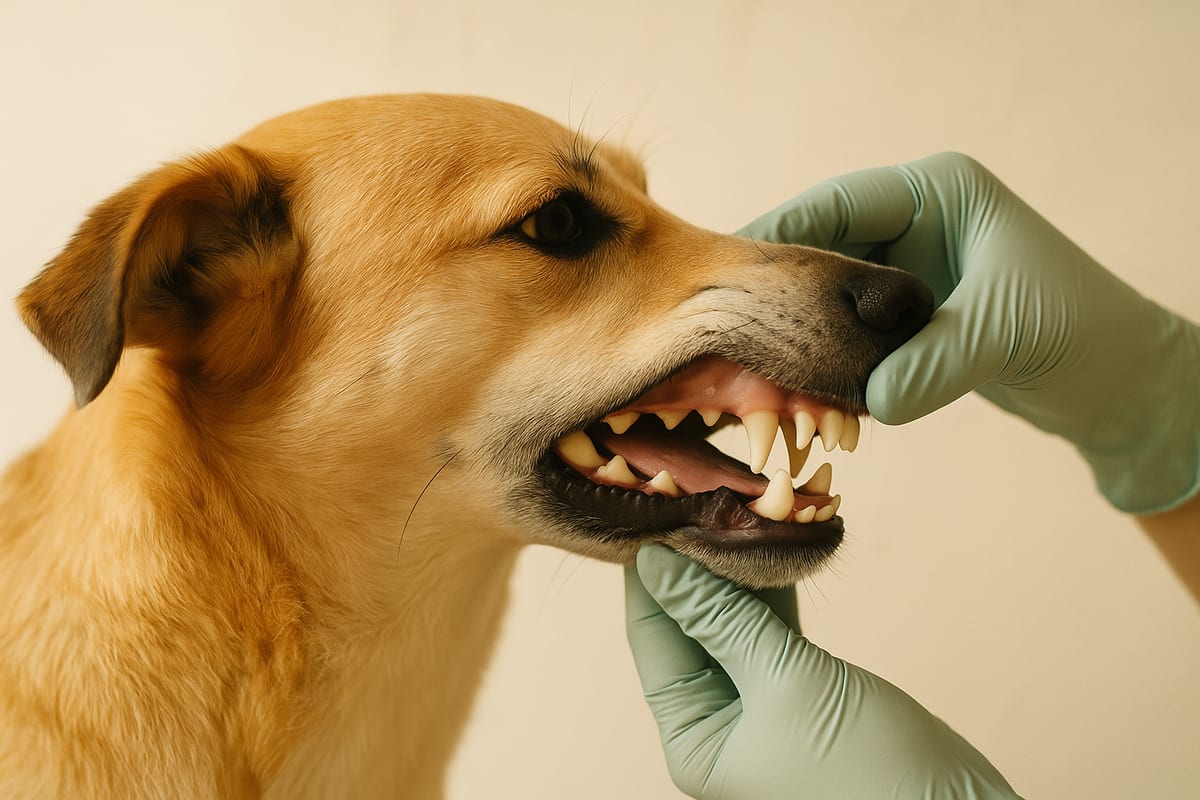
If you brought your dog into my exam room tomorrow, there's an 80% chance I would diagnose them with some form of periodontal disease before they turn three years old. That number is from the American Veterinary Dental College. It hasn't moved in twenty years.
Most pet parents don't know this — because we've built an entire industry around the appearance of dental care that obscures the underlying mechanics of what's actually happening in our dogs' mouths. The result: a generation of dogs reaching old age with mouths that look fifteen years older than they are, and a steady stream of $500–$1,500 vet bills that owners didn't know were coming.
Here's what's going on. And here's what actually works.
What "dental disease" really means in a dog
Periodontal disease is the inflammation and infection of the structures that hold teeth in place — gum tissue, the periodontal ligament, and the bone of the jaw. It's caused by bacteria. The bacteria form plaque (a soft film), which hardens into tartar within 24–72 hours, which then traps more bacteria at the gum line. The body responds with inflammation. The inflammation eats away at the tissue and bone. Eventually teeth loosen, abscess, and fall out.
Here's the part most owners miss: it's almost entirely silent for the first two stages. Stage 1 (gingivitis) shows up as a thin red line at the gum margin. Stage 2 (early periodontitis) shows up as visible tartar plus mild bone loss on X-ray. Dogs don't show pain at either stage. Many won't show pain until stage 4, when the disease is advanced and tooth extractions are usually required.
Most owners don't realize there's a problem until their dog stops eating on one side of their mouth. By then, the damage is already done.
Why kibble + "dental treats" can't fix this
The market has responded to the dental crisis the way it usually does — with products that look like they're solving the problem while sidestepping the actual mechanism. Let's walk through them:
1. Crunchy kibble doesn't clean teeth
The "kibble polishes teeth" claim got into pet-care folklore decades ago and has stuck around despite the evidence against it. The reality: kibble shatters on first bite without making contact with the tooth surface long enough to scrape plaque. Most dogs barely chew kibble at all — they crunch it once or twice, then swallow.
2. Most "dental treats" are starch with a marketing budget
Read the ingredient list on the leading dental treats and you'll find: wheat, corn, rice, glycerin, sugars, binders, flavor sprays. These ingredients feed the same bacteria they claim to fight. The chew is also engineered to break apart in a few bites — perfect for marketing, useless for mechanical cleaning.
3. Brushing is great. It also basically never happens.
The veterinary consensus is that brushing your dog's teeth daily is the gold standard. The reality is that fewer than 7% of owners do it more than once a week, and almost none do it daily. We can keep telling owners to brush — or we can build a protocol that actually fits their lives.
What actually works: mechanical cleaning by real animal tissue
The thing that does reduce plaque, in study after study, is sustained mechanical contact with the tooth surface during chewing. This is how wild dogs maintain their teeth. They don't brush. They tear flesh and gnaw on cartilage and bone.
The closest analog we can ship to a modern dog is single-ingredient, slow-dehydrated animal tissue. The chew has to be:
- Real protein. Tissue scrapes plaque. Starch doesn't.
- Slow-dehydrated. High-temperature extrusion destroys the structure that does the work and the nutrients that come with it.
- Sustained. 10+ minutes of chewing per session. Bite-and-swallow doesn't move the needle.
- Rotated. Different proteins have different textures that scrape different tooth surfaces.
The 75-day ritual
Dental care works through consistency, not a single chew. That's why the NAVAN protocol is one chew a day, built around a 75-day arc. Every dog is different; these are milestones to watch for, not guarantees.
Day 25 — fresher breath. Daily chewing supports natural oral hygiene through mechanical cleaning. Fresher breath may become noticeable.
Day 50 — cleaner-looking teeth. Consistent chewing supports ongoing oral care. Teeth may appear cleaner.
Day 75 — sustained oral support. Ongoing mechanical cleaning sustains the result. A daily chew complements professional veterinary dental care; it never replaces it.
What to do if you suspect dental disease in your dog
Three things:
1. Look in the mouth. Lift the lip on each side. Look at the gum line at the upper molars (the back teeth). Red line right where the tooth meets the gum is gingivitis. Yellow-brown crust on the tooth is tartar. Either one means it's time to act.
2. Schedule a vet check. Especially if there's bad breath, missing teeth, dropping food, or chewing on one side only. Dental X-rays are the only way to see the bone loss that defines periodontal disease. Get the full picture.
3. Start a real protocol. Whether you go with navan or build something else, the protocol has to involve actual mechanical cleaning, ideally daily. The protocol we built is here. If yours involves real chewing on real tissue, you're on the right track.
The bigger point: dental disease in dogs is the most common health problem we treat, the easiest to prevent, and the one most pet parents don't know about. We can change that. One protocol at a time.
The 80% figure cited above is from the American Veterinary Dental College.