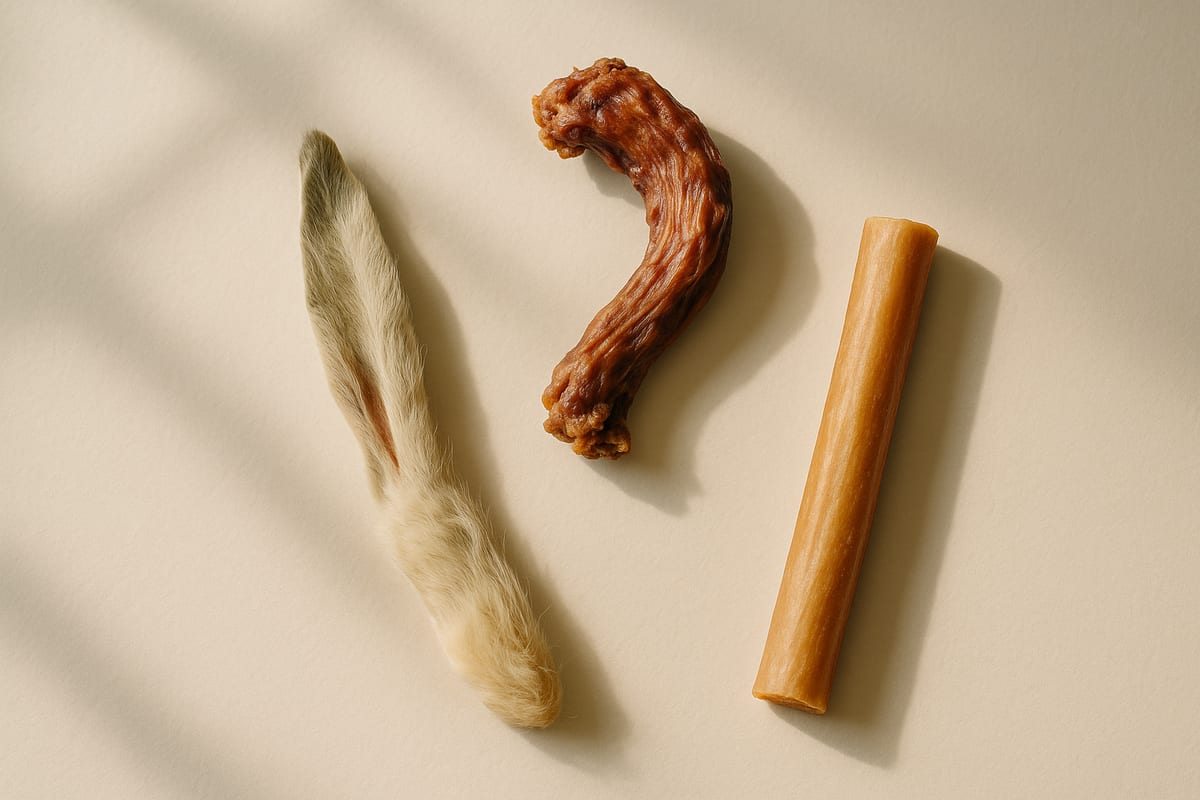
When we launched navan in late 2024, the first product we sold was a single-protein subscription — rabbit ears, shipped monthly. It worked. Dogs liked it. Owners reported fresher breath within a month.
Then we started seeing something interesting in the outcome data: the dogs on a three-protein rotation had measurably better gum-line health at the 60-day mark than the dogs on a single protein. Same total chew time. Same daily ritual. Different proteins.
That finding pushed us to redesign the brand around the bundle — and it's the reason every navan box ships with three different chews instead of one.
Here's why rotation does what it does.
The four-way job your dog's mouth is doing
Dental disease isn't one process. It's four overlapping problems happening on different tooth surfaces, simultaneously:
- Plaque on the smooth tooth surface — the cheek-facing side of the molars. Needs scraping action.
- Plaque on the inter-dental margin — between teeth. Needs a chew that can wedge in and clean the gap.
- Tartar accumulation at the gum line — the line where tooth meets gum. Needs sustained, soft contact.
- Bacteria in the gingival sulcus — the tiny pocket inside the gum. Needs gum-line stimulation and saliva flow.
No single chew texture solves all four jobs well. A chew that's hard enough to scrape smooth surfaces is too dense to wedge between teeth. A chew soft enough to clean the inter-dental margin won't move plaque off smooth surfaces.
This is the same reason your dentist tells you to use both a brush and floss and a water pick. Different tools, different jobs.
How the three core bundle proteins divide the labor
Each protein in the core bundle has a deliberately different texture, and each one targets a different one of those four jobs:
rabbit ears — soft, broad, fibrous
The softest chew in the lineup. Doesn't scrape — it sweeps. Spends time against the smooth surface of the molars, working plaque off through sustained contact. Dogs tend to "fold" it as they chew, which gets it into the cheek-side molar region.
Best at: smooth surface plaque, fresher breath quickly, gentle on senior teeth.
Rabbit stick — twisted, dense, long-lasting
The puzzle chew. Twisted form factor means it wedges between teeth and into the inter-dental margin. Dense enough to slow chewing down (30+ minutes for many small dogs), which extends gum-line contact time.
Best at: inter-dental cleaning, gum-line stimulation, focused chewing time.
Duck neck — whole bone, mineral-dense
The mineral boost. Whole bone with cartilage means calcium and phosphorus during digestion — supporting bone structure of the jaw itself. The crunch is different from the other two: short bursts of force on individual teeth.
Best at: smooth-surface scraping with force, minerals to bone, jaw musculature.
One chew can do one job well. Three chews, rotated, do four jobs reasonably well — which is how you actually move the needle on dental disease.
Why rotation also matters for the dog's interest
There's a behavioral piece, too. Dogs habituate to repeated stimuli faster than people realize. Owners of single-protein subscribers often report that their dog gets "less interested" in the chew over time — they still eat it, but with less focus, which means less chewing time, which means less mechanical cleaning.
The dogs on rotation show no habituation pattern. Each day's chew is different enough to maintain interest. We see longer per-session chew times across the rotation cohort, which is the second-most important variable in our outcome data after total time on protocol.
How often to rotate
The protocol we recommend is the simplest possible: one protein per day, cycled across three days. Day 1 rabbit ears, Day 2 rabbit stick, Day 3 duck neck. Repeat.
Some owners get creative — splitting chews into morning/evening rituals, or rotating two proteins per day. The data doesn't show any meaningful difference from these variations. The thing that matters is that different proteins get into the mouth across the week. The exact cadence is up to you.
What this means for which bundle you should pick
For small dogs (0–20 lbs), the core bundle — rabbit ears, rabbit stick, duck neck — is the rotation we've optimized for small jaws. Gentler proteins, sized right, designed to handle all four cleaning jobs across the week.
For large dogs (20+ lbs), the endurance bundle — duck neck, duck wing, collagen sticks — is the same logic with denser proteins built to last for stronger jaws. Same four-job coverage, scaled up.
Either way, the protocol works the same way. Three chews. Rotated daily. The cleaning does itself.