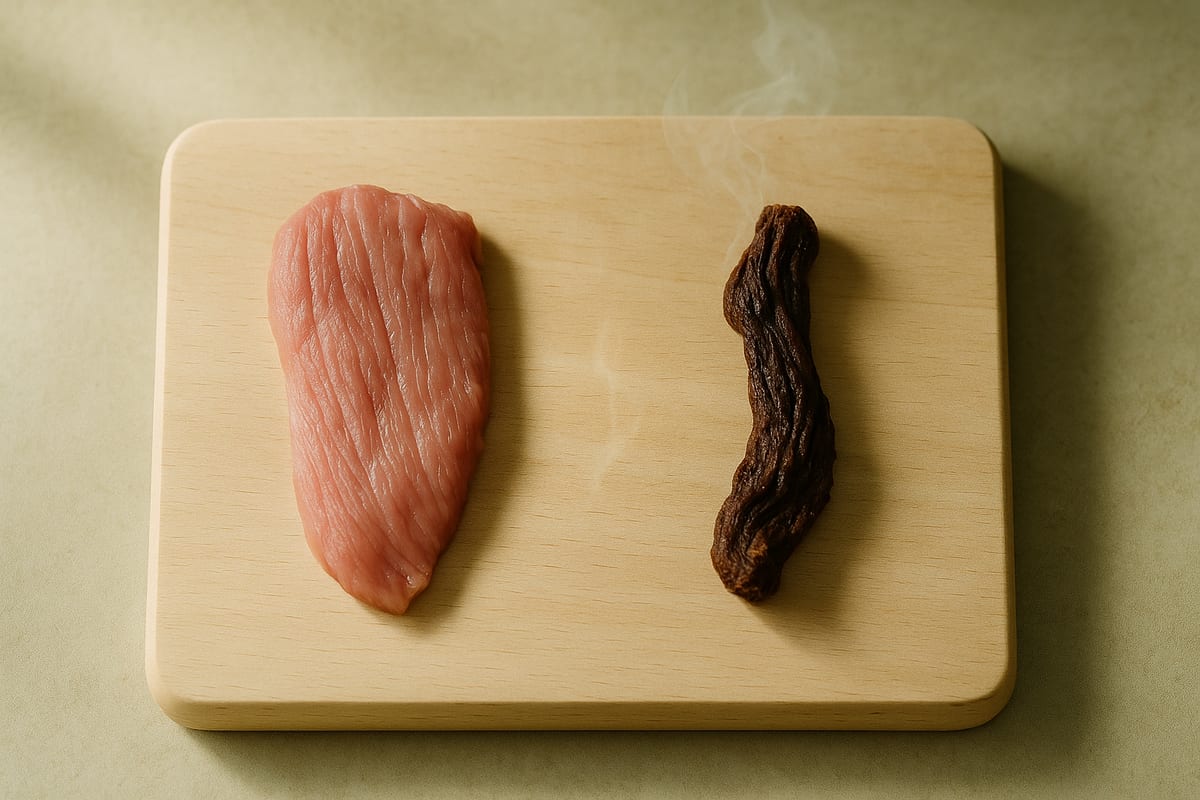
Most of the conversation about dog food and chews fixates on the ingredient list. Rabbit ear, duck neck, beef collagen — the noun on the front of the bag. We think that is the wrong place to start. Two brands can begin with the same protein and end up with two completely different products, because the processing method does more to the final nutrient profile than the ingredient itself does. A chew that started as a clean single-ingredient protein and then ran through a high-temperature extruder is not the same chew it was when it went in. Most pet parents have never been told this. We want to walk through what actually happens inside the two dominant manufacturing methods — extrusion and slow-dehydration — and why we build everything in the core bundle the second way.
What extrusion actually is
Extrusion is the workhorse of the pet food industry. A ground slurry of protein, starch, fat, and water is first mixed and steam-conditioned in a preconditioner, then fed into a long heated barrel where rotating screws push it under intense pressure toward a shaped die at the end. According to the 2021 literature review by Tran and colleagues in Animal Feed Science and Technology, commercial pet food extruders run at barrel temperatures of roughly 90 to 200°C and pressures in the range of 30 to 60 bar. Industry guides on preconditioner design typically report a total residence time of around 30 seconds in the barrel system, with the actual time at the high-pressure die measured in fractions of a second before the dough explodes out and puffs into the kibble or treat shape you recognize.
That puffing is the whole point. The pressure drop at the die flashes off water and expands the starch matrix into something shelf-stable, calorically dense, and cheap to ship. It is a remarkable piece of food engineering. It is also, by any honest accounting, a fairly violent thermal event to ask of a piece of meat.
What gets destroyed in the barrel
The damage shows up in three measurable ways. None of them appear on the bag.
Thiamine (vitamin B1)
Thiamine is the canary in the coal mine for heat damage, because it is one of the most thermolabile nutrients in the food supply. The Tran review and earlier work summarized in it report thiamine losses across pelleting and extrusion processes commonly in the range of 50 to 85%, with destruction rates rising sharply as product temperatures climb above roughly 107°C. The same review notes that B-group vitamins are, in relative terms, among the more stable in extrusion — fat-soluble vitamins A, D, E, K and vitamin C tend to fare worse — but "more stable than vitamin C" is still a long way from "intact."
Lysine, via the Maillard reaction
This is the quieter loss, and probably the more important one. When reducing sugars and the free amino group of lysine collide under heat, they bond. The lysine is still there on a total-amino-acid assay — it just no longer functions as lysine. A 2014 survey of commercial pet foods by van Rooijen and colleagues, published in the Journal of Nutritional Science, measured the ratio of reactive (bioavailable) lysine to total lysine and found it averaged 0.87 in extruded dog foods versus 0.97 in canned, with the lowest individual value — 0.77 — appearing in an extruded diet formulated for growing dogs. The authors note within-category variation was wide, so ingredient choice matters too, but the directional gap between extruded and canned was statistically significant.
Taurine
The FDA's investigation into diet-associated dilated cardiomyopathy is still ongoing and still complicated. The agency itself has noted that the vast majority of reported cases were on traditional hot-extruded dry food, and has named ingredient sourcing, formulation, and processing as factors it is still working to disentangle. We are not going to overstate a quantitative taurine-loss number here — the published literature does not yet support a single clean figure — but the consistent direction of evidence is that wet and minimally processed formats preserve sulfur amino acids more reliably than high-heat extrusion does.
If a process routinely destroys half a vitamin and quietly handcuffs an essential amino acid, calling the result "complete and balanced" is a labeling exercise, not a nutritional one.
What slow-dehydration looks like instead
Slow-dehydration is, mechanically, the opposite philosophy. Instead of forcing moisture out in fractions of a second with steam and pressure, we pull it out gently with warm circulating air over a long stretch of time — typically 60 to 70°C across 12 to 48 hours, depending on the cut and thickness. There is no die, no shear, no puffing. A rabbit ear that goes into the dehydrator looks like a rabbit ear when it comes out, only drier and harder. A duck neck still has the architecture of a duck neck.
That architectural intactness is the point. Because the protein never gelatinizes and the temperature never crosses the threshold where Maillard browning runs away, the amino acids stay reactive, the B-vitamins survive in something close to their native ratios, and the fibrous structure of the tissue is preserved — which is what gives the chew its mechanical abrasion against plaque in the first place. You cannot floss a tooth with extruded mush. You can with a slow-dried duck neck.
Why most brands extrude anyway
It is not a mystery. It is economics. Extrusion lines run continuously and turn raw slurry into bagged kibble in under an hour. Slow-dehydration is a batch process measured in days per run, with dramatically lower throughput per square foot of facility and far higher labor and energy cost per finished pound. The processing-cost differential is large enough that it shows up at the shelf — minimally processed single-ingredient chews are consistently more expensive than their extruded equivalents, and not by a little.
We think that is the honest price of not breaking the food. Most brands have decided their customers will not pay it, so the question never gets asked on the bag.
The "natural" label loophole
This is the part that we find hardest to defend on behalf of the industry. Under AAFCO's official definition, a feed ingredient counts as "natural" if it has been subjected to physical processing, heat processing, rendering, purification, extraction, hydrolysis, enzymolysis, or fermentation — essentially every industrial method except outright chemical synthesis. Extrusion at 180°C and 50 bar is "natural." Pelleting is "natural." A protein whose lysine has been Maillard-locked into uselessness is still "natural." The FDA, for its part, has declined to define the term for pet food at all, leaving the floor to AAFCO's permissive reading.
The result is a category where the word on the front of the bag tells you almost nothing about what happened to the food inside it.
What to do
- Read past the noun. "Chicken" or "rabbit" on the label is the starting ingredient, not the finished one. Look for the processing method — words like slowly dehydrated, air-dried, or a stated temperature and time range — and be skeptical of bags that won't say.
- Treat structure as a feature. A chew that still looks like the body part it came from is doing two jobs at once: delivering intact protein and mechanically scraping the tooth surface. Puffed, uniformly-shaped treats can do neither.
- Match the chew to the dog. Our protocol sizes single-ingredient dehydrated chews to small jaws specifically because the abrasion-and-nutrition logic only works if the dog can actually engage with the chew for several minutes.
The bigger point is this. The pet food industry has spent decades optimizing for the wrong variable — cost per shelf-stable pound — and has built a regulatory vocabulary that lets it call the result whatever it wants. "Natural" is a marketing word. "Complete and balanced" is a formulation target measured before the heat is applied. Neither tells you whether the lysine in your dog's bowl still works as lysine. Slow-dehydration is slower and more expensive, and we are not going to pretend otherwise. It is also, as far as we can tell from the published science, the only way to put a piece of meat in front of a dog and have it still be a piece of meat when it gets there.
Key sources: Tran et al., literature review on vitamin retention during extrusion of dry pet food, Animal Feed Science and Technology (2021); van Rooijen et al., reactive lysine in commercial pet foods, Journal of Nutritional Science (2014); FDA updates on diet-associated DCM investigation; AAFCO Official Publication, definition of "natural."