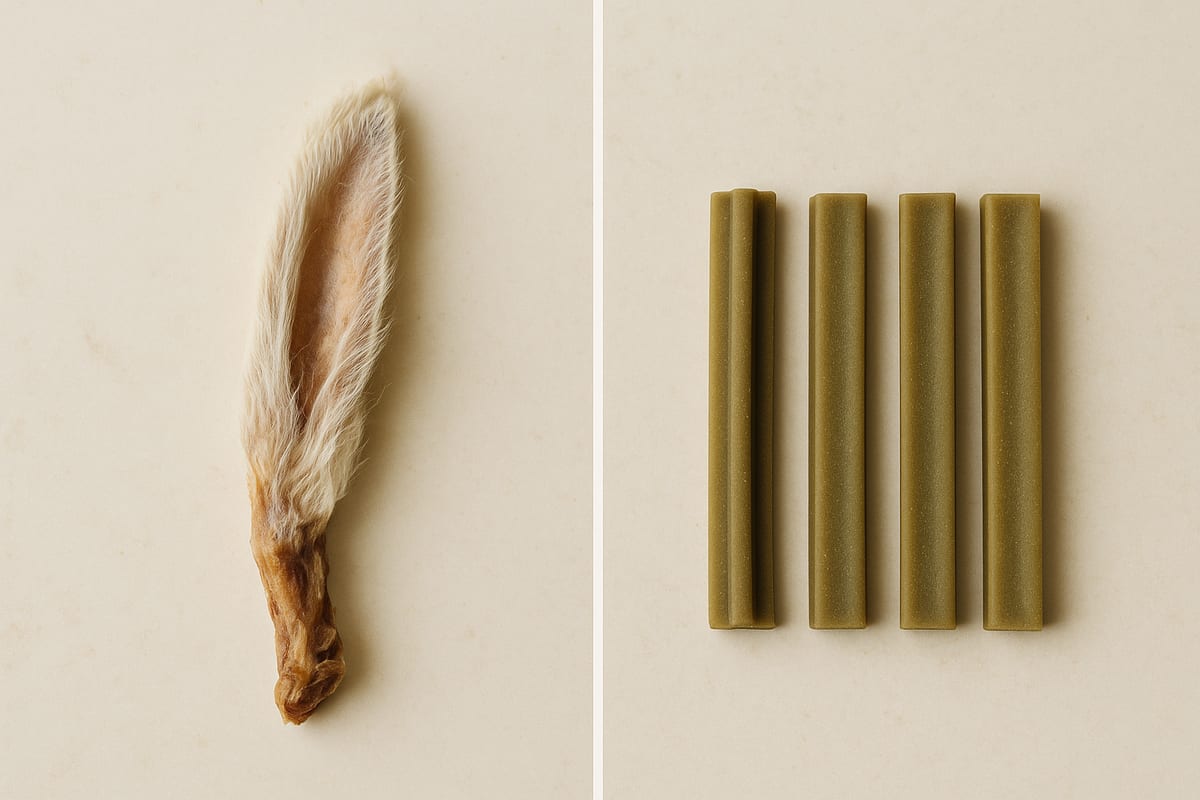
Walk into any pet aisle and you will see a wall of green, beige, and bone-shaped objects promising clean teeth, fresh breath, and a healthier dog. Most of them — Greenies, Pedigree Dentastix, OraVet, Whimzees — are extruded starch products that have very little in common with the food a dog evolved to chew. We think the category is overdue for a sober look, and we think the answer is simpler than the marketing suggests.
This is not a piece about scaring anyone. It is about reading the back of the bag.
1. What is actually in a "dental" treat
Start with the ingredient panels, which are public. Greenies Original lists wheat flour, glycerin, wheat gluten, gelatin, water, powdered cellulose, lecithin, and natural poultry flavor before you get to anything resembling a mineral. Pedigree Dentastix Original leads with rice flour, wheat starch, glycerin, and gelatin, with gum arabic, sodium tripolyphosphate, and "natural poultry flavor" further down. Whimzees, often positioned as the cleaner option, are still built on a base of potato starch and glycerin, set with yeast and lecithin.
The pattern across the category is the same: a starch matrix bound with glycerin, set with gelatin or gum, and flavored to make it palatable. Glycerin in particular is doing a lot of structural work — it keeps these chews pliable on the shelf — and at meaningful inclusion rates it is, technically, a sugar alcohol. That is the food. The shape is the marketing.
2. The VOHC seal is narrower than it looks
Many of these treats display the Veterinary Oral Health Council (VOHC) seal, and most owners read that seal as a clinical endorsement. It is something more specific. The VOHC is an independent body that reviews manufacturer-submitted trial data; per its published Trial Protocol Requirements, a product earns the "Helps control plaque" or "Helps control tartar" claim if it shows a statistically significant 15% reduction in plaque or calculus versus a negative control in each of two trials, with an average of at least 20% across the pair.
Fifteen percent. That is the bar. It is a real bar — these are blinded, scored trials — but it is not "cleans your dog's teeth." A treat can carry the seal while leaving 80% of the plaque exactly where it was, and the seal says nothing about ingredient quality, calorie load, or what happens to the gums underneath. The PetMD primer on VOHC makes the same point: the seal certifies a single, narrow efficacy threshold, not overall oral health.
3. The calorie problem nobody talks about
A Greenies Teenie — the size marketed for 5 to 15 lb dogs — runs about 26 kcal per chew. The Regular size, for 25 to 50 lb dogs, is closer to 90 kcal. A 12 lb dog has a maintenance requirement of roughly 280 to 320 kcal per day. One "daily" dental treat is therefore 8 to 10% of that dog's entire caloric budget — before any food, any training treat, any scrap. Run two a day, as many owners do, and you are quietly feeding a fifth meal of refined starch.
This matters because the same companies that sell the treats publish weight-management versions of them, which is a tell. If the original product weren't a meaningful caloric load, the weight-management SKU wouldn't exist.
A starch chew that reduces plaque by 15% while adding 10% to a small dog's daily calories is not, on balance, a dental product. It is a cookie with a claim on the box.
4. The Greenies precedent
The category's safety story is not theoretical. In February 2006, CNN reported on at least 13 dogs whose deaths owners and veterinarians linked to Greenies, after the chews lodged in the esophagus or small intestine and failed to break down. By March of that year, the FDA's Center for Veterinary Medicine had logged 35 complaints involving 34 dogs and one cat, as dvm360 documented at the time. A veterinarian quoted in the CNN piece described pieces removed from a dog's GI tract days after ingestion as "still very hard."
Greenies co-founder Joel Roetheli, in remarks reported by the Baltimore Sun on February 23, 2006, acknowledged that the company had reimbursed costs for as many as 20 fatalities. The product was reformulated that year and the brand was acquired by Mars Petcare shortly after. We are not arguing that today's Greenies are the 2005 product. We are arguing that an extruded, compressed starch chew, marketed to be swallowed daily, sits in a category whose failure mode is well-documented and whose physics have not fundamentally changed.
5. Starch is what plaque eats
The deeper irony is biochemical. Dental plaque is a bacterial biofilm, and the organisms that dominate it — Streptococcus, Actinomyces, and related saccharolytic genera — are fermenters. A 2022 study published in the Journal of International Society of Preventive & Community Dentistry compared refined and unrefined sugar substrates and found that the refined-sugar group showed roughly a nine-fold increase in Streptococcus and a large increase in Actinomyces — exactly the populations that drive plaque.
Dogs are partially protected here. Their saliva is alkaline (pH around 7.5) and low in amylase, which is why true dental caries are rare in dogs even on poor diets. But plaque and gingivitis are not caries — they are biofilm and inflammation, and the substrate for that biofilm is the same refined starch the treat is largely made of. Feeding a starch chew to fight plaque is, at minimum, a strange loop.
What to do instead
Our position is not that nothing works. It is that the mechanical part of dental care — the part that actually scrapes a tooth — wants a different kind of object.
- Replace the daily synthetic chew with a single-ingredient one. A rabbit ear, a duck wing, a length of beef collagen — anything dense enough to require real jaw work and made of one thing you can name. See the core bundle for the rotation we ship.
- Treat the VOHC seal as a floor, not a ceiling. If a product is helping at all, that is good. It is not a substitute for a chew that does mechanical work, and it is not a substitute for a brush.
- Count the calories. Whatever you give, subtract it from the day's food. A dental chew that pushes a dog into a higher weight bracket has done more harm than any plaque it removed.
The larger point is this: the dental-treat aisle exists because owners want a one-object solution to a multi-front problem, and the industry has built a category around that wish. Our protocol is the opposite shape — fewer ingredients, more chewing, and a clear-eyed view of what a 15% reduction actually buys you. The teeth, in our experience, prefer it.
Sources: VOHC.org trial protocol requirements; CNN (Feb 13, 2006) and dvm360 reporting on the 2006 FDA Greenies investigation; Baltimore Sun (Feb 23, 2006) on Joel Roetheli's remarks regarding reimbursed fatalities; manufacturer ingredient panels for Greenies, Pedigree Dentastix, and WHIMZEES; PetMD primer on the VOHC seal; and a 2022 study in the Journal of International Society of Preventive & Community Dentistry (PMC9753916) comparing refined and unrefined sugars in the oral microbiota.