
dental health · 6 min read
halitosis in dogs, a small-dog field guide.
what the word actually means, why small jaws get it early, and the daily habits that keep it from coming back.
the short version
- halitosis is persistent, abnormal breath odor with a physical cause, not everyday "dog breath."
- most cases trace back to periodontal disease, plaque and tartar building up on and below the gumline.
- small dogs are more prone to it, crowded teeth in a small jaw trap plaque faster.
- daily brushing plus a daily chew supports the routine between professional cleanings, they don't replace either one.
Every dog's breath has a little something to it. Halitosis in dogs is different: it's a smell that doesn't go away, gets worse over weeks or months, and usually means something specific is happening in the mouth. For small-dog owners, that "something" often shows up younger than expected, small jaws pack the same number of teeth into far less room, and crowded teeth trap plaque quickly. Here's what actually causes it, what's normal to ignore, and what's worth a call to your vet.
what is halitosis in dogs?halitosis in dogs is persistent, abnormal-smelling breath with a physical cause, not the mild "dog breath" every dog has. it's most often a symptom of periodontal disease, plaque and tartar building up on and below the gumline, rather than a condition on its own. occasional food breath fades in hours; halitosis doesn't.
The word gets used loosely, but vets draw a real line. A dog who just ate something smelly has food breath, and it clears on its own. A dog whose breath is consistently off, day after day, has halitosis, and that's the mouth (or occasionally the body) telling you it needs attention. It's worth reading as a symptom, not a personality trait some dogs are just stuck with.
what causes canine halitosis?
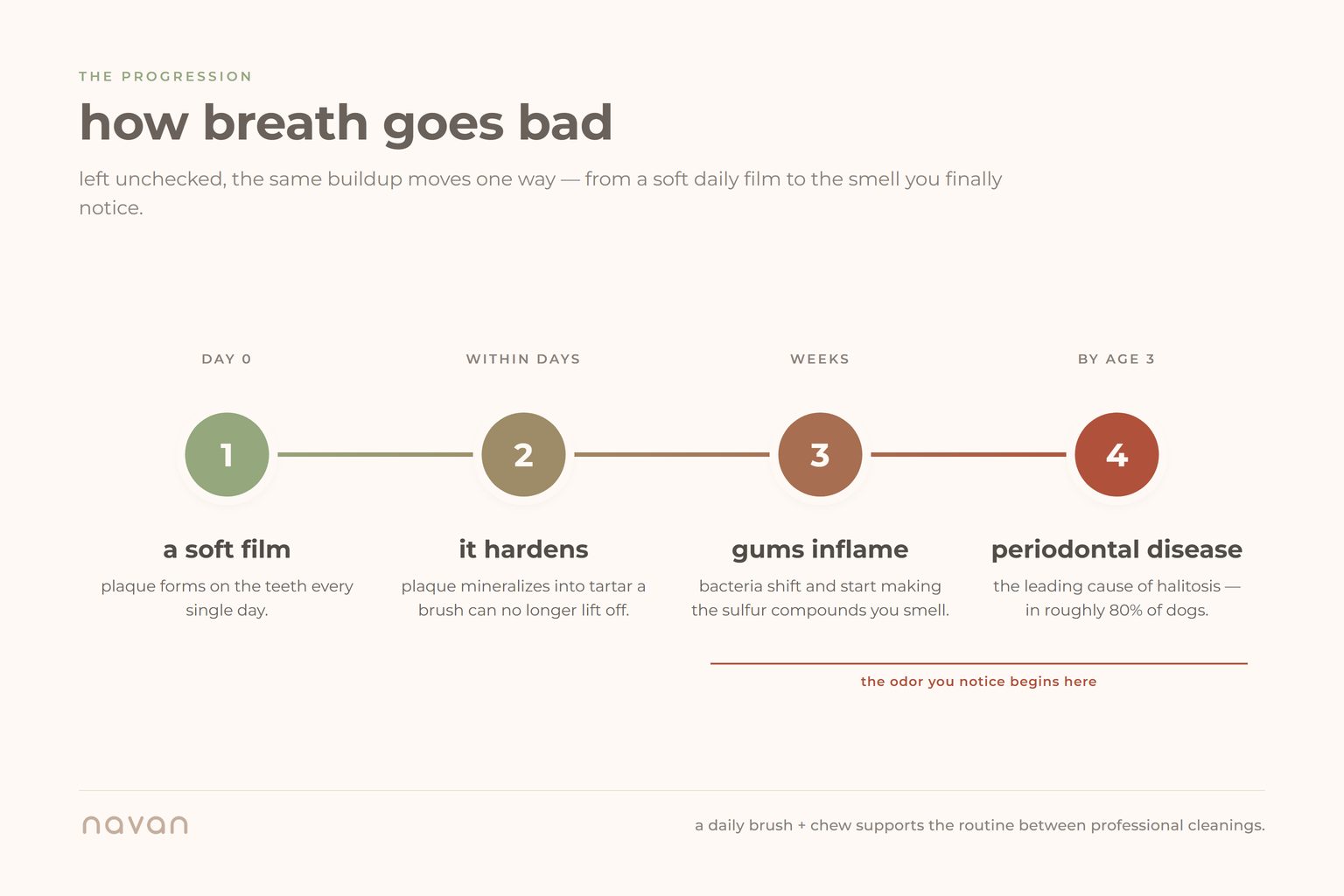
the leading cause is periodontal disease, the plaque-and-tartar buildup that inflames gums and lets odor-causing bacteria take over. less common causes include retained food in periodontal pockets, teething in puppies, oral tumors, or a systemic issue like kidney or liver disease. most cases, though, trace straight back to the teeth.
According to VCA Animal Hospitals, the most common cause of halitosis in dogs is periodontal disease arising from plaque and tartar build-up. As plaque ages into tartar, gums inflame, and the bacteria living in the mouth shift from a mostly harmless population to one that produces foul-smelling volatile sulfur compounds, the actual source of the smell. Periodontal disease is also, by a wide margin, the most common clinical condition seen in adult dogs, according to the American Veterinary Dental College, and the American Veterinary Medical Association puts the number at roughly 80% of dogs affected by age three. We cover that full picture, and what to do about it, in our dental disease deep dive.
| cause | what else you might notice | what it usually means |
|---|---|---|
| periodontal disease | tartar on the back teeth, red or bleeding gums | plaque control needed, vet exam if advanced |
| retained food debris | smell after meals, worse around gum pockets | often improves with brushing or a chew habit |
| puppy teething | loose baby teeth, chewing everything | usually temporary, resolves as adult teeth come in |
| kidney or liver disease | ammonia or unusually foul odor, increased thirst | needs a vet visit, not a home routine |
| diabetes | sweet or fruity note, increased thirst or urination | needs a vet visit |
why do small dogs get smelly breath so easily?
small dogs pack the same 42 adult teeth into a much smaller jaw, so teeth sit closer together with less room for saliva to naturally rinse plaque away. that crowding lets tartar build up faster and earlier than in larger dogs, which is part of why toy and small breeds show dental disease, and the breath odor that comes with it, at a younger age.
VCA notes that smaller and flat-faced breeds face elevated risk partly because of closer tooth spacing and a tendency toward softer diets, both of which give plaque more places to hide and less mechanical wear to fight it off. That's the whole logic behind a daily chew: it adds the friction a crowded small mouth doesn't get on its own.
is dog breath odor ever a sign of something serious?
occasionally. most breath odor is dental, but a sudden change, or a specific smell like ammonia, sweetness, or a sour, sickly note, can point to kidney disease, diabetes, or liver disease. pair that with new symptoms like increased thirst or lethargy and it's worth a vet visit, not a wait-and-see.
The everyday version of "dog smelly breath" is dental, plain and simple. What changes the calculus is a sudden shift in the smell itself, or new symptoms alongside it. We go deeper on exactly which smells map to which conditions, and when to worry, in is bad breath in dogs a sign of illness? If your dog's breath smells specifically fishy, that's its own pattern worth reading on its own, see why your dog's breath smells like fish.
how do you get rid of halitosis in dogs?
start with a dental exam to rule out disease that needs treatment, then build a daily habit: brushing removes plaque before it hardens, and a daily chew adds mechanical scraping between brushings. together they support the routine between professional cleanings, they're prevention, not a fix for teeth already affected.
VCA's own prevention guidance points to daily plaque control and products carrying the Veterinary Oral Health Council seal, the closest thing this category has to independent, trial-tested proof. A 2024 study in the Journal of Animal Science fed dogs a daily dental chew for 28 days and measured a real drop in breath volatile-sulfur compounds, the specific molecules behind the smell, alongside lower calculus and gingivitis scores. That's the mechanism a daily chew is built on: less plaque, fewer odor compounds, calmer gums.
minimum plaque or tartar reduction under the VOHC trial protocol, with results statistically significant (p<0.05). source: Veterinary Oral Health Council.
- brush daily. brushing reaches every tooth surface and is the gold standard for removing plaque before it hardens.
- add a daily chew. a hard, single-ingredient chew adds mechanical scraping on the chewing teeth, between brushings.
- book a professional exam twice a year. a vet cleaning catches disease below the gumline that no chew or brush reaches.
None of this replaces the exam your vet already recommends, twice a year for most adult dogs, more often for small breeds prone to crowding. What a daily routine does is keep the days between those exams from undoing the last cleaning. Not sure where to start? Size and texture matter as much as ingredient, and the 30-second chew finder narrows it down for your dog.
halitosis isn't a smell to mask. it's a mouth asking for a daily habit it isn't getting yet.

rabbit ears · 10 day supply
$35 one-time · from $29.75/mo on subscription
add to cart → live from shopify · price & stock always currentthe navan take
the part most breath articles skip is geometry. a small dog carries the same forty-two teeth as a labrador in a jaw a fraction of the size, which means crowding, overlap, and gaps no brush head reaches. that is why the risk curve for periodontal disease runs so much steeper at the bottom of the weight chart, and why generic dental advice underserves precisely the dogs who need it most. we design for the crowded mouth, because the crowded mouth is where this disease lives.
frequently asked
what is halitosis in dogs?
what causes canine halitosis?
is dog breath odor ever a sign of something serious?
how do you get rid of halitosis in dogs?
not sure where to start?
build your dog's dental protocol in 60 seconds.
answer a few quick questions and we'll match the single-ingredient chews that fit your dog's size, mouth, and needs.
take the dental quiz →sources: VCA Animal Hospitals, on periodontal disease as the leading cause of halitosis, small/flat-faced breed risk, and home-care recommendations; American Veterinary Dental College, periodontal disease as the most common clinical condition in adult pets; American Veterinary Medical Association, periodontal disease affecting roughly 80% of dogs by age three; Veterinary Oral Health Council, trial protocol requirements for the Seal of Acceptance; Oba, P.M. et al., "Effects of a novel dental chew on oral health outcomes, halitosis, and microbiota of adult dogs," Journal of Animal Science, 2024.
want navan's latest guides and updates to reach you more often? add us as a preferred source on google.
add navan as a preferred source on google